Read the original post on Linkedin here
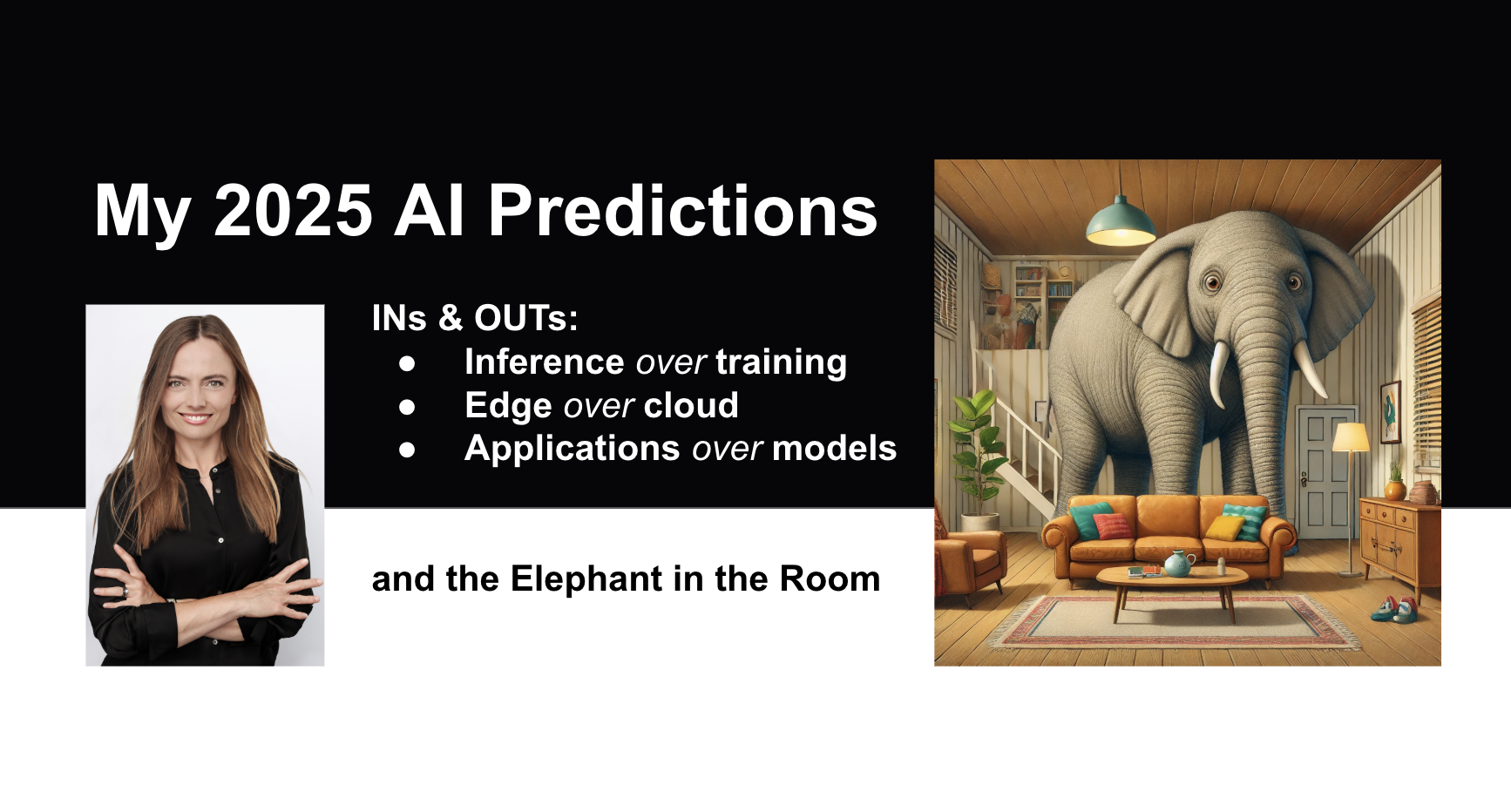
With the latest AI darling, DeepSeek AI, wiping billions off the market value of US tech giants just yesterday, 2025 is already shaping up to be a fascinating year for AI. The rapid evolution of AI, its promises, pitfalls, and shifting priorities, sets the stage for a year full of disruption. Here are my predictions for what’s IN and what’s OUT in AI for 2025:
AI Tech Stack: OUT with Training Obsession, IN with Inference*
The obsession with training massive models is OUT. What’s IN? Ruthlessly efficient inference. In 2025, if you’re not optimizing for inference, you’re already behind. Here’s why.
The cost of achieving OpenAI o1 level intelligence fell 27x in just the last 3 months, as my Google Cloud colleague Antonio Gulli observed – impressive price-performance improvement.

The recent DeepSeek AI breakthrough proves this point perfectly. Their R1 model (trained for just $5.6 million, a fraction OpenAI’s rumored 500 million budget for its o1 model), achieves feature-parity and even outperforms major competitors in key benchmarks:

We clearly figured out how to make LLM training more effective and cost efficient. Time to reap the benefits and use the models for inference.
*We will still be enhancing LLMs’ capabilities, developing smaller, purpose-built models and re-training them with new data-sets.
AI Architecture: OUT with Cloud-First, IN with Edge-First**
The pioneers in the most AI-advanced industries like Manufacturing have exposed the limitations of cloud-first AI approaches. According to Gartner, 27% of manufacturing enterprises have already deployed edge computing, and 64% plan to have it deployed by the end of 2027. Why the rush to edge-first AI architectures?
In industrial applications, especially those requiring real-time control and automation, latency requirements as low as 1-10 milliseconds demand a fundamental rethinking of distributed AI system design. At these speeds, edge-to-cloud roundtrips are impractical; systems must operate as edge-native, with processing and decision-making happening locally at the edge.
One of Synadia‘s most innovative customers, Intelecy, a No-Code AI platform that helps industrial companies optimize factory and plant processes with real-time machine learning insights, perfectly illustrates this paradigm shift. Their initial cloud-first approach had processing delays of 15-30 minutes. By redesigning their AI architecture for the edge, they achieved less than one-second round-trip latencies. This dramatic improvement enabled real-world applications like automated temperature control in dairy production, where ML models can provide real-time insights for process optimization.
Processing data where it is generated isn’t just more efficient—it’s becoming a competitive necessity for every industry. Gartner predicts that by 2029, 50% of enterprises will use edge computing, up from just 20% in 2024.
**The cloud’s role in AI isn’t disappearing (of course), but the default is shifting rapidly towards edge-first thinking.
AI Impact: OUT with What-If, IN with What-Now***
Focusing on model capabilities is OUT. What’s IN? Solving real business problems. The most compelling AI stories in 2025 won’t mention model architecture. Instead, they’ll focus on measurable business impact.
Intelecy’s Chief Security Officer 🔐 Jonathan Camp explains how AI can help ensure quality in manufacturing: “A dairy can use a machine learning forecast model to set temperature control systems using the real-time predicted state of the cheese production process. The process engineering team can use Intelecy insights to identify trends and then automate temperature adjustments on a vat of yogurt to ensure quality and output are not compromised.”

The shift is clear: success is no longer measured in model capabilities, but in hard metrics like revenue gained, costs saved, and efficiency improved. The question isn’t “What can AI do?” but “What value did it deliver this quarter?”
***As an innovation-obsessed marketer, I’l never give up on “what-if” dreams but “what-now” is the state of AI in 2025.
The Elephant in the Room: Can gen AI be trusted?
We’ve solved training costs. We’ve started to crack real-time processing. Now, the focus shifts to trust: Can AI deliver consistent, reliable, and verifiable results at scale?
For example, try to ask 3x gen AI bots this prompt 3x, and see for yourself:
Name top 3 ski resorts in Europe by the total length of ski runs that are truly interconnected (no bus transfers)
We’re entering the era of agentic AI where AI-made decisions will be automatically implemented by chains if AI-functions. Are we ready?
What’s on your IN/OUT list for 2025?
#AIin2025 #Data #AI #DataAndAI #Tech2025 #FutureOfAI #Inference #Training
Comments
4Simone Morellato and 3 others


Add a comment…
Open Emoji Keyboard
No comments, yet.
Be the first to comment.Start the conversation

 Tech Surprises