On the heels of my Marketing Plan for Tech Startups launch during TECH WEEK by a16z, I had the joy of hand-delivering copies to some of the people who shaped my marketing journey: teachers, mentors, and icons whose ideas live inside these pages.
At Stanford University Graduate School of Business, I sat down with Professor Baba Shiv, whose groundbreaking research on the neuroscience of decision-making forever changed how I think about marketing. He taught me that 95% of our decisions are driven by emotion, not logic — a truth that still holds in B2B, even when the stakes involve multi-year contracts and enterprise deals.
Stanford GSB: With Prof. Baba Shiv this week (2025) and the cohort of the Innovative Technology Leader program (2023)
AtGoogle , I met with Jeanine Banks whose leadership at Google Developer X taught me what it truly means to innovate inside a large organization. Working for Jeanine was a career highlight for me and her ability to bootstrap new initiatives and help teams “execute and win like a startup” inspired many of the ideas I share in the book.
Google: With Jeanine Banks this week (2025) and during my Noogler orientation (2018)
And at Y Combinator, I caught up with Pete Koomen, Partner at YC and Co-founder of Optimizely, one of Silicon Valley’s great success stories. His Startup School talk on enterprise sales remains one of my favorites, and key lessons from that lecture made their way into this book.
Wth Pete Koomen at Y CombinatorPete’s quote for the Marketing Plan for Tech Startups
Every stop on this tour felt like a full-circle moment: celebrating the people and ideas that helped build the foundations this book stands on.
Where shall I make the next stop on the book tour?
Inspired by Priyanka Vergadia’s demo showing how she built a full-stack app in minutes with GitHub Spark, I gave it a try. Spark is GitHub’s new AI-powered app builder that runs entirely in your browser. No setup. No config. No need to remember Java classpath from my mobile and web app developer days. 😉
Just describe what you want, and Spark builds it end-to-end: front-end, database, authentication, etc. As always, Priyanka did an awesome job walking her YouTube channel viewers through all the steps of using GitHub Spark to go from zero-to-app, so I thought: why not?
The PRD aka my wish list for a book reader
I mostly wanted three things:
A two-page view so if you read on a big screen it feels like an actual book in front of you.
A search function so you can instantly jump to “positioning,” “pricing,” or “Anthropic case study.”
Bookmarks and notes, so readers can mark sections and write down thoughts as they read (my paperback margins are always full of notes and post-its 😉)
Three features I dreamed up, let’s see what I got.
GitHub Spark
How GitHub Spark turned my PRD into a working e-reader
I typed my requirements in natural language, hit submit, and Spark went into “think mode.”
A few minutes later, I had a working prototype: two-page display.
A couple of hours later (and with a few vibe-coding-hacks I’ll detail below) I added keyword search and a bookmark system. Here’s the finished product:
My e-reader vibe-coded in an afternoon
My e-reader vibe-coded in an afternoon looks very promising but is not quote ready to ship just yet. Here’s why:
Lessons learned from vibe-coding an e-reader in GitHub Spark
First, while Spark gave me the basic app scaffolding quickly, it struggled to render a PDF heavy with graphics. Sometimes it showed only text, other times it spit out binary data.
Spark’s default PDF handling just wasn’t built for a manuscript like mine. My book isn’t a typical wall of text. I wrote it in Google WorkspaceSlides to make it as much a tool as a book, packed with frameworks, diagrams, and visuals that startup founders and marketers can apply right away. The format was deliberate: keep the text lean, rely on visuals, and use slides as a constraint so every word carries weight.
I knew from a previous vibe-coding session that v0 by Vercel could handle a heavyweight manuscript like mine, so I thought: why not ask Vercel how it did it? The answer was pdfjs-dist, the distributable version of Mozilla’s PDF.js, which renders PDFs natively in the browser without plugins. I plugged it into Spark and—yay—I was unblocked!
Second, as I layered on more prompts and features, I learned that Spark projects can hit limits and stop accepting prompts.
The first prototype was quick and easy, refining it took patience… and some help from ChatGPT. When Spark stopped accepting prompts, I pulled down the GitHub ZIP, then used ChatGPT to reverse-engineer Spark’s app architecture and rebuild the project with more detailed instructions.
This experience pretty much sums up today’s vibe-coding scene: vibe-hackers are out of the box thinkers who juggle multiple tools; when one doesn’t do what you need, you pick up another.
My final lesson: vibe-coding is a lightning-fast way to prototype and experiment but it still takes time to create a production-grade app ready to be shared with others. That’s why for now, I’m only sharing screenshots.
Just like with my “Slide Tools” hackathon two weeks ago, I was reminded of the real promise of AI-driven coding:
The future of software with AI: everyone can be a creator.
The next generation of apps — whether e-readers or enterprise apps — will be powered by AI, built faster than ever, and customizable to fit customer needs with precision.
And some of those apps will be built by marketers.
Marketers as vibe-coders
“Vibe Marketers” are already starting to appear on job boards:
“We’re looking for a Vibe Growth Marketing Manager who is a builder who prototypes and ships faster than most teams can spec a brief. You’ll use AI tools, LLMs, no-code/low-code platforms, and smart automation to rapidly unlock new growth channels, improve operational efficiency, and experiment with new marketing ideas end-to-end.”
It’s clear that vibe-coding is becoming essential for speed and efficiency in marketing workflows.
But why stop at workflows? What if marketers could also be the first prototypers of new product ideas?
Marketers as product prototypers
Marketers are already customer advocates and trend spotters. Vibe-coding tools now give them the ability to turn insights directly into working prototypes, bridging the gap between customer voice and product innovation.
With vibe-coding, marketers can also extend existing products with new features requested by their customers, as I demonstrated in my “Slide Tools” hackathon.
My custom slide tools I added to Google Slides
A sneak peek into my book’s vision
Elevating marketers into co-creators of product is central to my book’s vision. My goal is to restore marketing to Kotler’s full “4 Ps” (product, price, place, promotion), rather than the narrow “1 P” of promotion it’s often reduced to. Vibe-coding tools may be the superpower that helps marketers reclaim all four.
If you’re a startup founder or marketing leader, my upcoming book Marketing Plan for Tech Startups project distills lessons from Fortune 500 companies and startups into practical frameworks to break through the noise and turn innovation into revenue.
I’m also thrilled to share that the one and only Priyanka Vergadia is among its distinguished contributors! 😀
This weekend, I pulled off my own hackathon. The challenge? Cleaning up 200+ Google Slides of my upcoming book: Marketing Plan for Tech Startups.
Why so many edits?
After a year of experiments and contributions from several collaborators, each with their own style, the deck had turned into a Frankenstein: fonts all over the place, inconsistent sizes, text boxes scattered. Original thinkers are not known to stick to templates. 🤪
Why did I write a book in Google Slides?
Because I wanted to create a tool as much as a book, a resource startup founders and marketers can apply right away. My rationale: keep text lean, rely on visuals, and use slides as a constraint so every word carries weight.
As the book launch at TECH WEEK by a16z in San Francisco this October approaches, the thought of unifying it all was daunting. Manually cleaning 200+ slides would take days, and still never be perfectly consistent.
So I turned to AI. It thrives on repetitive and grueling work, the kind humans struggle to do well. I just needed to get it inside Google Slides.
How to vibe-code away the pain of manual slide edits
First, I accessed App Script under “Extensions” in Google Workspace Slides:
Accessing Google Slides API via Apps Script
Second, I used Windsurf to vibe-code the features I wanted:
From a single prompt…
… I got ready to use code and a deployment guide in seconds.
Third, I pasted the code into Apps Script…
Apps Script in Google Slides
… and just like that, I got the first tool. Quick test… It works, yay!
I continued with more prompts to build functions like updating colors to a specific shade of black or changing fonts to Lato.
Soon enough, I had my own full set of “Slide Tools” to tame 200+ slides. ⬇️
My custom set of “Slide Tools”
Maybe in addition to publishing a book, I should start a side hustle selling Google Slides automations. After all, I have already got one very polished deck to prove it works. 😉
One more thing
Like every good hackathon, this one came with a “one more thing.” It reminded me of the real power of vibe coding: when products open APIs, anyone can go beyond the defaults, shape tools their own way, and turn a generic product into something personal.
The future of software with AI: everyone can be a co-creator.
And with vibe coding democratizing access to computer programming, that future is close and attainable.
Everyone can make a popular tool even more useful.
As a marketer, I’m excited about the future of software. I’ve spent my career helping emerging technologies find their market and convert innovation into sales. That same spirit is what I poured into my upcoming book. Marketing Plan for Tech Startups is meant to be a practical guide that helps founders and innovators do the same.
And just like a product with open APIs, this book is built to be extended. If you’d like to add your perspective or contribute to future editions, I’d love to hear from you.
Please comment below or send me a DM, and I’ll be in touch!
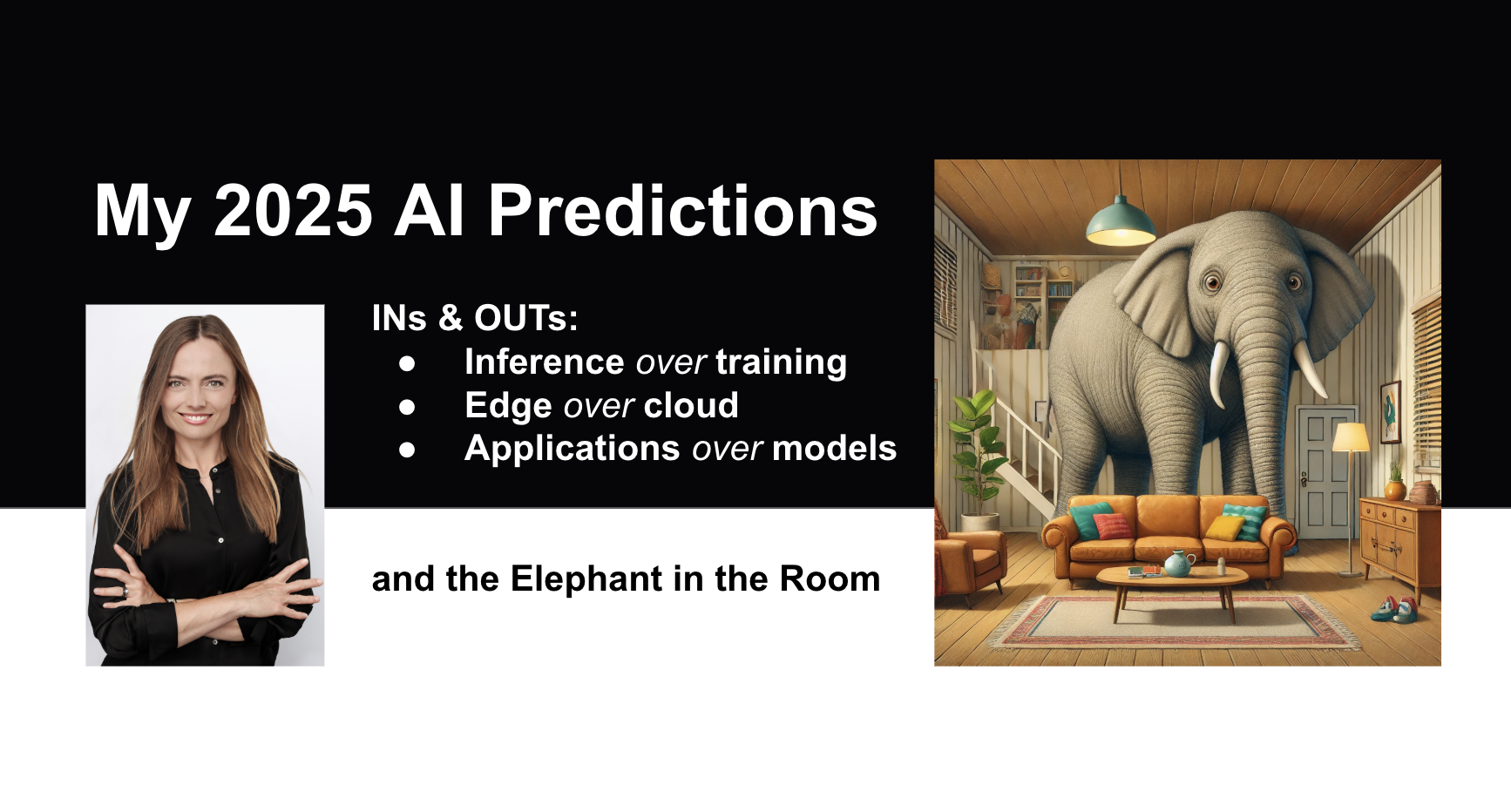
With the latest AI darling, DeepSeek AI, wiping billions off the market value of US tech giants just yesterday, 2025 is already shaping up to be a fascinating year for AI. The rapid evolution of AI, its promises, pitfalls, and shifting priorities, sets the stage for a year full of disruption. Here are my predictions for what’s IN and what’s OUT in AI for 2025:
AI Tech Stack: OUT with Training Obsession, IN with Inference*
The obsession with training massive models is OUT. What’s IN? Ruthlessly efficient inference. In 2025, if you’re not optimizing for inference, you’re already behind. Here’s why.
The cost of achieving OpenAIo1 level intelligence fell 27x in just the last 3 months, as my Google Cloud colleague Antonio Gulli observed – impressive price-performance improvement.
The recent DeepSeek AI breakthrough proves this point perfectly. Their R1 model (trained for just $5.6 million, a fraction OpenAI’s rumored 500 million budget for its o1 model), achieves feature-parity and even outperforms major competitors in key benchmarks:
We clearly figured out how to make LLM training more effective and cost efficient. Time to reap the benefits and use the models for inference.
*We will still be enhancing LLMs’ capabilities, developing smaller, purpose-built models and re-training them with new data-sets.
AI Architecture: OUT with Cloud-First, IN with Edge-First**
The pioneers in the most AI-advanced industries like Manufacturing have exposed the limitations of cloud-first AI approaches. According to Gartner, 27% of manufacturing enterprises have already deployed edge computing, and 64% plan to have it deployed by the end of 2027. Why the rush to edge-first AI architectures?
In industrial applications, especially those requiring real-time control and automation, latency requirements as low as 1-10 milliseconds demand a fundamental rethinking of distributed AI system design. At these speeds, edge-to-cloud roundtrips are impractical; systems must operate as edge-native, with processing and decision-making happening locally at the edge.
One of Synadia‘s most innovative customers, Intelecy, a No-Code AI platform that helps industrial companies optimize factory and plant processes with real-time machine learning insights, perfectly illustrates this paradigm shift. Their initial cloud-first approach had processing delays of 15-30 minutes. By redesigning their AI architecture for the edge, they achieved less than one-second round-trip latencies. This dramatic improvement enabled real-world applications like automated temperature control in dairy production, where ML models can provide real-time insights for process optimization.
Processing data where it is generated isn’t just more efficient—it’s becoming a competitive necessity for every industry. Gartner predicts that by 2029, 50% of enterprises will use edge computing, up from just 20% in 2024.
**The cloud’s role in AI isn’t disappearing (of course), but the default is shifting rapidly towards edge-first thinking.
AI Impact: OUT with What-If, IN with What-Now***
Focusing on model capabilities is OUT. What’s IN? Solving real business problems. The most compelling AI stories in 2025 won’t mention model architecture. Instead, they’ll focus on measurable business impact.
Intelecy’s Chief Security Officer 🔐 Jonathan Camp explains how AI can help ensure quality in manufacturing: “A dairy can use a machine learning forecast model to set temperature control systems using the real-time predicted state of the cheese production process.The process engineering team can use Intelecy insights to identify trends and then automate temperature adjustments on a vat of yogurt to ensure quality and output are not compromised.”
The shift is clear: success is no longer measured in model capabilities, but in hard metrics like revenue gained, costs saved, and efficiency improved. The question isn’t “What can AI do?” but “What value did it deliver this quarter?”
***As an innovation-obsessed marketer, I’l never give up on “what-if” dreams but “what-now” is the state of AI in 2025.
The Elephant in the Room: Can gen AI be trusted?
We’ve solved training costs. We’ve started to crack real-time processing. Now, the focus shifts to trust: Can AI deliver consistent, reliable, and verifiable results at scale?
For example, try to ask 3x gen AI bots this prompt 3x, and see for yourself:
Name top 3 ski resorts in Europe by the total length of ski runs that are truly interconnected (no bus transfers)
We’re entering the era of agentic AI where AI-made decisions will be automatically implemented by chains if AI-functions. Are we ready?
As a technology marketer, I’ve witnessed the Gen AI revolution from its inception. In early 2023, I crafted an enterprise narrative for Google Cloud, helping our global salesforce inspire customers to adopt this technology. I’ve seen AI evolve significantly: from chatbots writing silly poems to answering medical questions and guiding students in physics. Today, AI can understand, reason, and create across various inputs like text, images, audio, and video. I’m excited about AI’s potential to accelerate marketing innovation.
Now, as the VP of Marketing at Synadia, the startup on a mission to connect the world, I’ve observed even more. At a recent webinar for 50+ portfolio companies at Forgepoint Capital, I shared these insights, which I’m highlighting in this week’s newsletter. Thank you Tanya Loh for the opportunity!
As a technology marketer, I’ve witnessed the Gen AI revolution from its inception. In early 2023, I crafted an enterprise narrative for Google Cloud, helping our global salesforce inspire customers to adopt this technology. I’ve seen AI evolve significantly: from chatbots writing silly poems to answering medical questions and guiding students in physics. Today, AI can understand, reason, and create across various inputs like text, images, audio, and video. I’m excited about AI’s potential to accelerate marketing innovation.
18 months ago, I visualized gen AI as my alter ego, a game changer amplifying our strengths and overcoming our weaknesses. I hoped that for creative and curious people who tend to procrastinate and get bored easily, Gen AI would make life easier by handling the repetitive and mundane tasks we dislike.
Gen AI amplifies many our strengths and overcomes our weaknesses
Today, I can say that my prediction turned out to be true. I see three main buckets where Gen AI helps us in marketing:
✅ Expand your expertise
✅ Jump-start your creativity
✅ Offload your marketing tasks
I’ll illustrate how I’ve used Gen AI in marketing through stories with Google and Synadia.
Gen AI quickly expands our expertise and teaches us new skills
First, let me tell you how Gen AI helped me hit the ground running from Day 1 at Synadia and how it continues to my invaluable sidekick. I created a custom GPT to teach me about Synadia’s product portfolio. I trained it using public documentation. I knew the learning curve on the product built by the world’s brightest distributed systems engineers would be steep. Asking my personal GPT questions promptly got me up to speed.
Here’s another example. Imagine hearing a new acronym during a meeting with your engineers. Instead of interrupting the flow and making everyone wait while someone explains it, my Synadia bot, trained on github.com/synadia-io, immediately clarifies it for me. This way, we can stay focused on discussing our vision for building the ultimate platform for distributed applications without sidetracking the meeting.
My other story happened at Google. You may have seen ‘The Tale of a Model Gardener’ video, a humorous cartoon about Gen AI’s ability to help enterprises achieve their business goals. Gen AI accelerated the creative process for this video we launched ahead of #GoogleCloudNEXT in August 2023. Here’s how.
The idea hit me when cycling between San Francisco’s Marina District and Financial District to Google’s office. I wondered: “How do I explain concepts in AI, such as augmentation and prompt engineering, in fun, approachable ways?” The idea of a cartoon video surfaced but how to start, having never written a video script nor cartoon?
With just 30 minutes until my next meeting, I instructed Bard (now #GoogleGemini). “Hey, Gemini, write me a movie script about X.” I added three sentences with my idea. In minutes, I got a fully developed movie script, beautifully formatted by scenes. I perfected things with small additional prompts. Google #Vertex AI, an end-to-end ML platform, helped me generate images. I stitched together a script draft with some images and sent it to my creative colleagues–all within 30 minutes–and they really liked the idea of a cartoon. Though they had different ideas about what the cartoon ought to explain and how it ought to look; the concept landed from my Gemini experiment.
This triumph really shows what Gen AI brings us as marketers. I got a solid movie script within minutes, with no prior experience in building such things. I didn’t waste the idea, which became an important, valuable deliverable for the company.
Have you seen this fairy tale 🐇🥕🥧 about gen AI?
Gen AI sparks our creativity
I want to expand on how I use Gen AI to jumpstart my creativity, especially when short on time. As you can imagine, only a few weeks into the Synadia role, I’m working on our positioning and messaging. I brainstorm with my small but mighty marketing team, my product and engineering team, and my founder and CEO. I also brainstorm with Gen AI, especially when everyone’s busy. (My bot is always available.)
As the proud granddaughter of a professor of physics and a prolific dressmaker who whipped up gorgeous fashion from his patterns, I’ve long loved prototyping and testing my ideas. My mind works best when reacting to prototypes vs thinking about them. Prior to Gen AI, we had to write or sketch out our prototypes. Gen AI requires a simple prompt for a full document which can spark more ideas and creativity in ourselves and others. (We saw this with my design team at Google and ‘The Tale of a Modern Gardener’ AI-generated cartoon script.) For that same reason product demos are worth 1000 slides. Show, don’t tell.
Have you read our
Gen AI offloads small tasks
Gen AI also can offload small, repetitive, mundane tasks to free us up for more strategic thinking and exciting tasks. At Synadia and Google, Gen AI has helped me:
Jump-start projects. A custom prompt to generate case studies from our many great customer stories captured in blog posts and videos scaled our small team’s output.
Generate images. The early images for my first cartoon script for ‘The Tale of a Model Gardener’, weren’t perfect, but brought the narrative to life.
Edit content and minor things/ideas. While preparing my creative idea for the design team, I lacked the time for editing parallel construction in my lists or capturing typos. My bot took care of that so I could focus on creativity. Writing uses the creative part of our brain; editing uses the analytical. Mixing the two puts the breaks on the creative process so I like to offload the latter to my bot.
Gen AI helps us feel more experimental
Gen AI never lets an idea go to waste. When you’re pressed for time, quickly producing a first prototype helps your colleagues provide feedback faster. While you might discard that initial version, it speeds up the journey to the final product.
If a picture is worth a 1000 words, a prototype is worth a 1000 thoughts
Sometimes, a colleague may take your prototype in a completely new direction. I find this process empowering and encouraging. Each strong reaction, even a negative one, means I’m one step closer to the ideal solution.
Innovation thrives on collaboration and diversity, not egos. Gen AI helps create an environment where ideas evolve and improve through teamwork, making our solutions stronger and more innovative.
The drawbacks and obstacles with Gen AI
Gen AI has some drawbacks. A few I’ve encountered include:
Ubiquitous language. The bar for quality content has never been higher and savvy readers detect and tune out AI-generated if repetitive, generic, and vague. We’ve seen content overload for close to two years now. Cutting through that noise requires high-quality content.
Flawed responses. Use AI responsibly and not verbatim. AI bots are not deterministic. Our bot’s responses may be quick, but sometimes contain significant errors in reasoning. I wrote about this problem in my post on how I turned a daunting 150+ page-long voter pamphlet into a handy cheat sheet for the San Francisco elections. I prompted: “Summarize all the propositions on the March 5th 2024 SF election ballot with their top arguments for and against in a 3-column table using the voter pamphlet as the data source.” The bot’s quick response impressed me. But I found reasoning errors and one argument was entirely made up by the bot. Always check your results.
No slide fixes! Gen AI will not do what we dream of (yet): unify our fonts and texts in our slide decks 😂.
Change in Gen AI is unprecedented. I’ve seen nothing like this growth in my 15+ years in tech. The new features from OpenAI, Google or Anthropic are just the tip of AI innovation. Many startups work towards perfecting Gen AI as well. In the meantime, discovering gen AI feels amazing and I wonder how we lived without it.
Looking ahead
Despite all that Gen AI brings us as marketers, it cannot compete with human storytellers. Gen AI does not substitute well-written, well-narrated customer stories. Even OpenAl looks for interesting use cases of their products exploring new features in unexpected ways. So let’s provide them. A recent LinkedIn post on me using ChatGPT and a Peloton app to rediscover German became one OpenAI reposted, which sparked a wonderful conversation on learning new languages with Gen AI, all from a lighthearted, personal story connecting with technology, efficiency, and learning.
The previous edition of this newsletter reposted by Open AI
This moment reminds me: All Tech brands, even the Silicon Valley hottest companies like OpenAI, seek interesting stories on how we use their products in exciting, unexpected ways to start a community conversation.
For now, Gen AI cannot do that nor can it replace a great writer or story. That’s our opportunity and another way we can best partner with Gen AI as marketers and as storytellers.
➡ How do YOU use Gen AI in Marketing? Share your thoughts in the comments! ✍👇
➡ Need a hand getting started? Shoot me a message! ✍ ✉
“The Magic of Generative AI” is still my favorite talk I’ve ever given, hands down. I loved collaborating with Google’s top AI minds on the story and the visuals, building demos that showed how Vertex AI helps marketers like me, and connecting with fellow AI enthusiasts in awesome places like LA and Rome.
But the best part was diving deep into how large language models (LLMs) actually work, reading those mind-bending research papers, and piecing together the “magic” they create. Preparing this talk was like living Google’s innovation mantra: stay curious, experiment, build something useful.
In this newsletter, I’m sharing my reflections on the magic of Gen AI and how Google’s unique innovation culture was key to making these incredible tools a reality.
Curiosity, experimentation, and application: This is the heart of how Google is driving the generative AI revolution. It’s the same formula behind some of our biggest breakthroughs, like Google Search, Translate, and Vertex AI.
Here’s how it works:
Curiosity: This is where it all starts – that burning question of “what if?” or “why not?” Curiosity is what drives us to explore the unknown and challenge the status quo.
Experimentation: Curiosity without action is just daydreaming. Experimentation is where we get our hands dirty, trying new things, making mistakes, and learning from them. It’s the messy but essential part of the process.
Application: The ultimate goal of innovation is to create something that makes a real difference in the world. Application takes those wild ideas and experiments and turns them into practical solutions that people can use and benefit from.
This isn’t just a theory; it’s the blueprint behind Google’s most groundbreaking AI tools.
Embeddings in Google Search: Grasp query intent beyond exact keywords
In 2013, Google researchers authored the seminal paper “Efficient Estimation of Word Representations in Vector Space“. This paper unveiled a revolutionary method for creating Word Embeddings, mathematical representations of words capturing both their meaning (semantics) and relationships (semantic similarity). Here’s the Google’s innovation formula in action:
Curiosity: Dissatisfied with existing word organizational methods, such as dictionaries ordering words by lexicographical order, researchers were curious if a better approach could capture word semantics and organize them by semantic meaning.
Experimentation: They explored various neural network types, training objectives and relationship representations. Through experimentation, they discovered how to automatically create a word embedding. A name to be remembered, an embedding is a mathematical representation for each word that captures their semantic meaning in the form of a vector of 768 numbers.
Application: Way before it was applied in gen AI, word embeddings found a magical application in semantic search, enabling Google Search 🔍 to grasp query intent beyond exact keywords. For example, a search for “cars that are good on gas” now returns results for fuel-efficient cars, even if the word “gas” doesn’t appear in the options returned.
Source: “The Magic of Generative AI” talk, Google Gen AI Live and Labs event series
Transformer in Google Translate: More accurate translations
In 2017, Google researchers presented “Attention is All You Need” introducing the Transformer architecture, built on decision-making and attention-span concepts. It empowers the language models to understand context and relationships within word sequences. Curiosity, experimentation and application were again vital:
Curiosity: In the search to improve the quality of language translation, researchers sought ways to model relationships among words in a sentence.
Experimentation: They experimented with various mechanisms, relationship representations and training methods, discovering that much could be extracted by simply paying attention to the relationship between each word and every other word in a sentence. They discovered that these interdependencies could be achieved through parallel computations, which accelerated time to result, and found that representations through embeddings could capture long-range dependencies between words in fluent, grammatically correct text. Voilà! The Transformer architecture was born, introducing a huge breakthrough in science.
Application: The transformer revolutionized Google Translate 🌐. The Transformer’s attention mechanisms are excellent at understanding the relationships between words in a sentence, leading to more accurate translations.
Source: Transformers, FT,
Let’s see this in action by translating this sentence from English to Italian: “The cat didn’t cross the street because it was too wide.
Source: “The Magic of Generative AI” talk, Google Gen AI Live and Labs event series
Gen AI in Enterprise Search: New way of working
Fast forward to 2023, Google Cloud researchers set to simultaneously tackle two common challenges for many organizations:
How to organize enterprises information scattered across many internal systems
How to make this information accessible and useful for enterprises, and seamlessly available and actionable in applications such as customer service bots, document summarizations or as part of steps in automated workflows.
Not surprisingly, Google Cloud researchers followed the proven innovation framework:
Curiosity: While Google Search was designed to scale to organize the world’s information, researchers started exploring whether the technology could be descaled and made available to enterprises to organize their information in a way that could be easily accessible and useful to them, and only to them.
Experimentation: Intrigued by the potential to bring together several cutting-edge technologies, researchers used the ability to crawl web-sites to discover content on internal websites and structured content, and Optical Character Recognition (OCR) to discover content from all sorts of semi-structured and unstructured documents, creating a wealth of knowledge about the enterprise. The researchers then used embeddings to extract and organize the semantic meaning of all of this data. Once enterprise’s data has been semantically organized in embeddings, the full power of Generative AI can be applied to it and leveraged across the Vertex AI platform.
Application: First launched in March 2023, Google Cloud Vertex AI Search 🔍 quickly became “the killer enterprise app”. A killer application, often abbreviated as killer app, is a software application that is so necessary or desirable that it proves the core value of some larger technology, such as its video game console, software platform, or in this case of gen AI in the enterprise context. Killer apps are the pinnacle of innovation: well-designed, easy to use and solving a real problem for users. Enterprise Search is the killer enterprise app as it unlocks unprecedented levels of productivity and efficiency.
These transformative breakthroughs exemplify Google’s dedication to AI innovation, with continued explorations on the horizon.
I’m a Marketing Executive, an astute influencer, panelist, and public speaker with recent appearances on Harvard Business Review (HBR). I live and work in San Francisco.




 4Simone Morellato and 3 others


 LikeCommentShareComments settings


 Tech Surprises