Archive | Uncategorized RSS feed for this section

From West Egg to Pitch Deck: A Tech Marketer Guide to Gatsby-Grade Storytelling

14 Jul

Read it on Linkedin

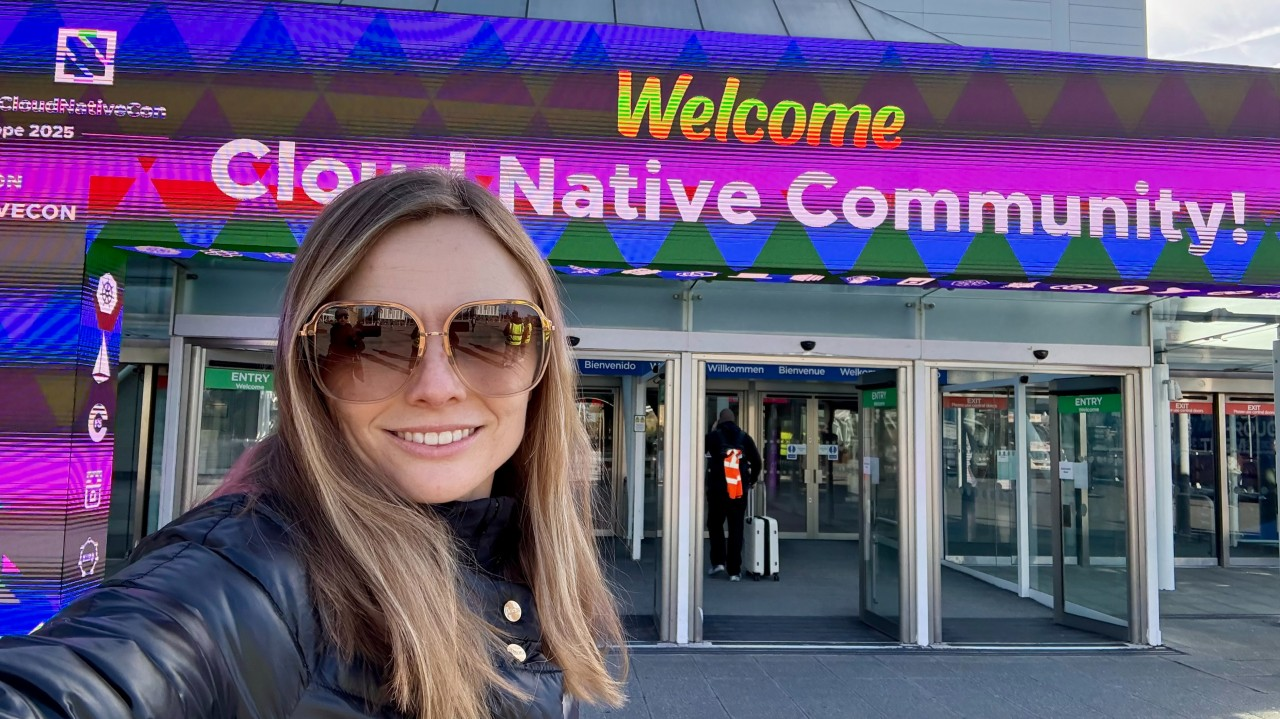
I was recently on a flight from London to San Francisco, returning home from KubeCon Europe, one of the major tech conferences in my industry. Too tired to read yet too alert to sleep, I found myself endlessly scrolling through the in-flight movie selection when I landed on The Great Gatsby (2013) starring Leonardo Di Caprio as Jay Gatsby. As I watched, I couldn’t help but think of the excellent Storytelling class taught by Professor Dan Klein, which I took as part of the Innovative Technology Leader at Stanford in 2023. Gatsby’s narrative arc, the stakes, transformation, and the tension in every scene brought those storytelling principles vividly back to life.

The very elements that have made Gatsby compelling for over a century are the same ones that can turn a customer case study or a pitch deck for a complex piece of B2B software into an irresistible narrative that captures prospective buyers’ attention.

Article content
“The Great Gatsby” by F. Scott Fitzgerald, America’s literature masterpiece, has captivated millions of readers since its 1925 publication and was adapted into several movies. This concise, 180-page impactful novel even made Time magazine’s All-time 100 novels list.

The following five lessons sum up what makes Fitzgerald an exceptional storyteller:

  1. Use a clear narrative structure that moves the audience from problem to resolution
  2. Layer sensory detail to make abstract value concrete
  3. Represent big ideas in symbols that makes them memorable
  4. Keep tension alive with surprise and mystery
  5. Close with a universal message that transcends features

Read on for the how and the why, plus a quick checklist that you can apply to Tech marketing, from your next product launch to your event keynote.

First: Apply a narrative structure

A finely crafted narrative structure guides “The Great Gatsby”:

  • Platform: The historical backdrop sets the stage with the initial circumstances of key protagonists before the main action.
  • Tilt: A pivotal event disrupts the established order, propelling the protagonist into the story’s central conflict and journey that follows.
  • Cascading Events: Subsequent challenges and obstacles intensify the story’s tension, complexity, and conflict. With the stakes raised, the narrative propels forward.
  • Climax/Change: The narrative peaks amidst a tense conflict through the protagonist’s central challenge, resulting in a pivotal change or revelation. This climax (the story’s most dramatic point) resolves the main conflict and tees off the conclusion.
  • New Reality: The climax’s aftermath shapes the new reality, ties up loose ends, and concludes the story while revealing how the characters’ world has changed, outcomes, lessons learned, and final closure.
Article content
Storytelling class at Stanford GSB, 2023

Fitzgerald constructs his novel upon a platform of Jazz Age opulence, setting the stage for the tilt: Gatsby’s obsessive quest for Daisy Buchanan’s love. This quest spirals into cascading events: lavish parties, clandestine meetings and tragic revelations that propel the narrative towards its climax: the confrontation at the Plaza Hotel, leading inexorably to the novel’s harrowing conclusion. In the wake of tragedy, characters must grapple with their new reality.

Why this works

According to Stanford’s professor Jennifer Aaker, “Stories are remembered up to 22 times more than facts alone.” A great narrative pulls your audience in and helps them absorb, remember and act on the information you’re sharing with them.

A superb narrative structure is a must for effective storytelling. Yet to truly captivate, we must go deep and sensory too.

Second: Compel your reader through rich sensory details

Fitzgerald’s narrative brings sensory details: sounds of laughter and jazz from Gatsby’s mansion, movement of his colorful shirts he’s throwing around, visuals of parties draw us to West Egg, a fictional town on Long Island. Through his writing, Fitzgerald crafts a vivid landscape that helps the reader feel the emotions of the main characters, from Gatsby’s relentless optimism to Daisy’s gloomy boredom.

As a storyteller, I’m stunned with Fitzgerald’s use of details to elevate the characters and our sensory experience as his readers. He describes Daisy and Jordan with poetic details:

“dressed in white, and their dresses were rippling and fluttering as if they had just been blown back in after a short flight around the house.”

Article content
Great Gatsby movie (2013)

(Gasp. Imagine incorporating metaphors like these in our pitches!) Or the moment Gatsby throws his shirts before Daisy, prompting her tears, blends visual, emotional, and even kinesthetic descriptions wows me. (Imagine sharing raw emotions like these in our storytelling, even a smidgen.) Talk about elevating your message. And making it stick.

Why this works

Neuroscience shows that language filled with vivid sights, sounds, textures and movement does more than delight readers. It lights up the same sensory circuits that fire during direct experience, which in turn deepens attention, improves memory, fuels emotion and nudges buying decisions. [Source: ScienceDirect]

You can make your product even more memorable by adding symbolism and dramatic techniques.

Third: Blend symbolism and themes

Fitzgerald’s use of the green light at the end of Daisy’s dock serves as a potent symbol throughout the novel. It represents Gatsby’s hopes and dreams for the future, particularly his desire to reunite with Daisy. This symbol encapsulates the themes of ambition, longing, and the disillusionment of the American Dream.

“Gatsby believed in the green light, the orgastic future that year by year recedes before us. It eluded us then, but that’s no matter—tomorrow we will run faster, stretch out our arms farther…. And one fine morning——”

This quote captures the perpetual and untethered pursuit of dreams that I find quintessentially American. Whenever I read it, I think of the pioneers and their tenacity, grit and perseverance that I found so captivating when watching Western movies as a kid that grew upon the other side of the world, in Poland, during a time of massive change and new beginnings.

Why this works

Symbols like Gatsby’s green light work because the brain sees them as shortcuts that trigger emotion. In enterprise software, a strong visual like a logo or icon (or a minimalist architecture diagram) can do the same. It taps into the part of the brain used to recognize faces, making it instantly recognizable. This helps people understand value quickly and with less effort. A great visual shows what your product does without making the viewer think too hard. [Source: Designing for recognition by Janine (Nock) Rosado]

Article content
DiCaprio’s GIF of Gatsby lifting a champagne glass has become the visual shorthand for Fitzgerald’s book.

Fourth: Utilize dramatic techniques

Fitzgerald’s use of surprise, suspense, mystery, and secrets keeps the reader engaged and enhances the storytelling. These elements create a sense of unpredictability, drawing readers deeper into the story as they seek to uncover hidden truths and anticipate outcomes. Integrating these techniques into your storytelling can captivate your audience, keeping them invested in the narrative from beginning to end.

Dramatic techniques including surprise, suspense, mystery, and secret enchant us and deepen an unpredictable tale. Memorable quotes capture the novel’s theme on the longing and elusive nature of the American Dream.

“Can’t repeat the past? Why, of course you can!”

Gatsby asserts, and with that, reminds us of the American’s unique confidence and ability to reinvent or recreate on a whim, a quality I adore about America and don’t quite find elsewhere.

Why this works

A mid-story twist grabs your audience’s attention and ensures they’ll more likely to remember your message. When the audience encounters information that breaks its prediction, it opens a window for stronger long-term memory formation. [Source PMC]

Fifth: Share a universal message

“The Great Gatsby” demonstrates the power of stories that, while rooted in a specific time and place, speak to universal human experiences and emotions. The novel’s adaptability to different eras through film adaptations underscores its timeless appeal and the enduring relevance of its themes. Crafting stories that tap into universal truths and emotions can ensure they resonate across different audiences and stand the test of time.

This is the opening line of F. Scott Fitzgerald’s “The Great Gatsby,” setting the tone for the novel’s exploration of themes such as privilege, judgment, and empathy.

“In my younger and more vulnerable years my father gave me some advice that I’ve been turning over in my mind ever since. ‘Whenever you feel like criticizing any one,’ he told me, ‘just remember that all the people in this world haven’t had the advantages that you’ve had.’”

Why this works

In enterprise software marketing, weaving universal messages (like the advice in Gatsby) builds a bridge between abstract technology and real human desire of belonging, purpose, or progress. A message such as e.g. Vercel‘s “Go ahead, ship on Friday” keeps the story sticky long after your pitch meeting.

Article content
Vercel ad in San Francisco, 2024

Bringing Gatsby’s lessons to Tech Marketing

As my flight descended into San Francisco, I reflected on how these storytelling principles could elevate my next marketing campaign. Contrary to the notion that Tech Marketing is all about listing features, the best marketers tell stories of transformation. And these stories speak to deep, human needs.

Like Gatsby’s green light, our products symbolize aspirations and possibilities. The tension between where our users are today and what they hope to achieve tomorrow creates the same narrative drive that fuels Fitzgerald’s masterpiece. Whether we’re writing the next great novel or a compelling launch campaign, the goal is the same: to connect, inspire, and offer a glimpse of a better future.

Below is a five-step playbook for turning any complex B2B pitch into a Gatsby-grade narrative buyers remember:

Narrative structure: guide readers from problem → pivotal complication (stakes rise) → solution → measurable results

Sensory details: turn metrics into moments your audience can see, hear, or feel, make them tangible vs. abstract

Symbolism & theme: repeat one memorable image or punchline that embodies your promise

Memorable reveal: drop a surprising fact or twist midway to reignite attention and prove credibility

Universal message: close by linking the outcome to a shared aspiration that outlives any single feature

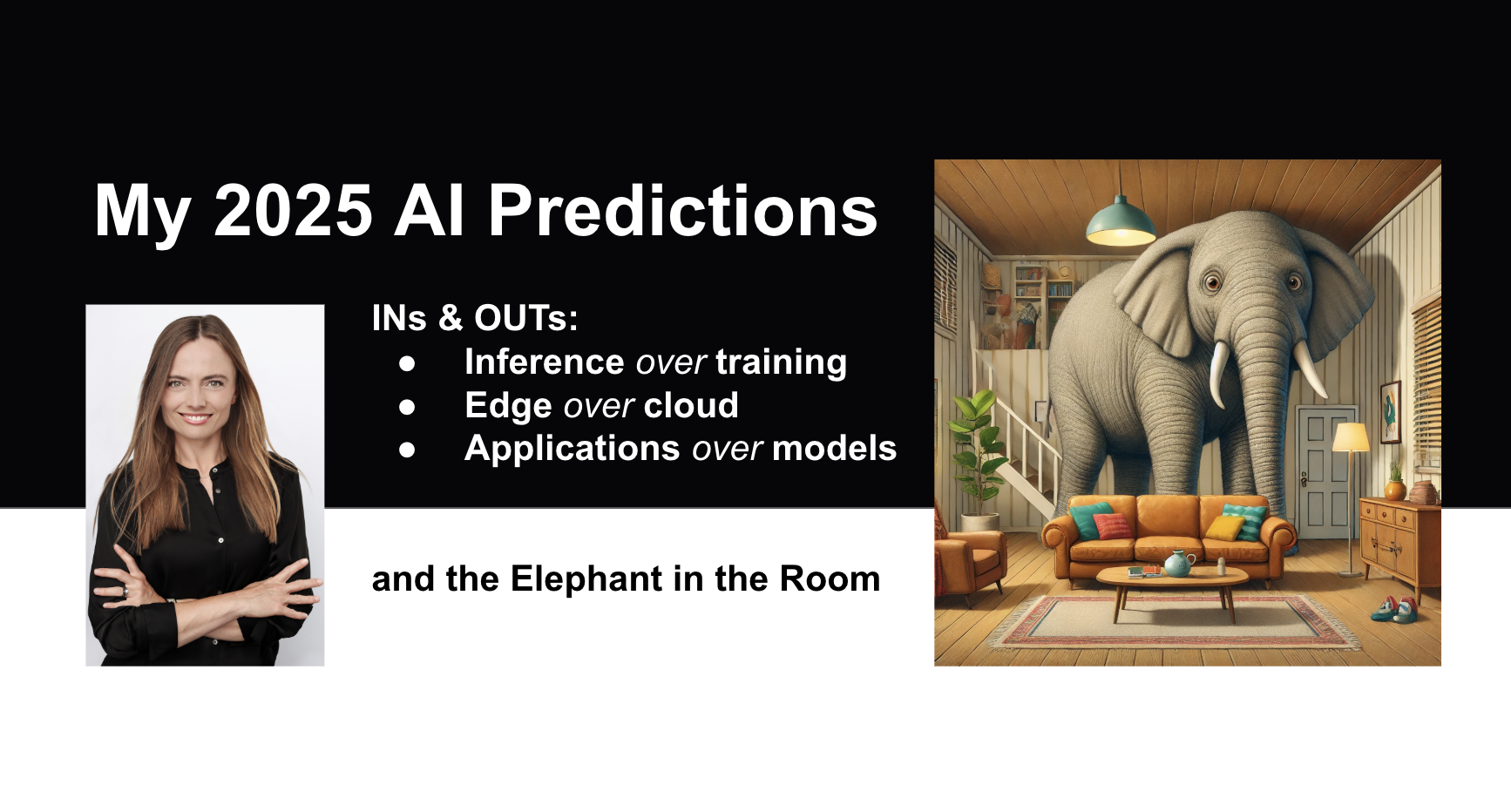
My 2025 AI Predictions: INs & OUTs

28 Jan

Read the original post on Linkedin here

With the latest AI darling, DeepSeek AI, wiping billions off the market value of US tech giants just yesterday, 2025 is already shaping up to be a fascinating year for AI. The rapid evolution of AI, its promises, pitfalls, and shifting priorities, sets the stage for a year full of disruption. Here are my predictions for what’s IN and what’s OUT in AI for 2025:

AI Tech Stack: OUT with Training Obsession, IN with Inference*

The obsession with training massive models is OUT. What’s IN? Ruthlessly efficient inference. In 2025, if you’re not optimizing for inference, you’re already behind. Here’s why.

The cost of achieving OpenAI o1 level intelligence fell 27x in just the last 3 months, as my Google Cloud colleague Antonio Gulli observed – impressive price-performance improvement.

https://www.linkedin.com/feed/update/urn:li:activity:7289697297397944320/

The recent DeepSeek AI breakthrough proves this point perfectly. Their R1 model (trained for just $5.6 million, a fraction OpenAI’s rumored 500 million budget for its o1 model), achieves feature-parity and even outperforms major competitors in key benchmarks:

https://arxiv.org/pdf/2501.12948

We clearly figured out how to make LLM training more effective and cost efficient. Time to reap the benefits and use the models for inference.

*We will still be enhancing LLMs’ capabilities, developing smaller, purpose-built models and re-training them with new data-sets.

AI Architecture: OUT with Cloud-First, IN with Edge-First**

The pioneers in the most AI-advanced industries like Manufacturing have exposed the limitations of cloud-first AI approaches. According to Gartner, 27% of manufacturing enterprises have already deployed edge computing, and 64% plan to have it deployed by the end of 2027. Why the rush to edge-first AI architectures?

In industrial applications, especially those requiring real-time control and automation, latency requirements as low as 1-10 milliseconds demand a fundamental rethinking of distributed AI system design. At these speeds, edge-to-cloud roundtrips are impractical; systems must operate as edge-native, with processing and decision-making happening locally at the edge.

One of Synadia‘s most innovative customers, Intelecy, a No-Code AI platform that helps industrial companies optimize factory and plant processes with real-time machine learning insights, perfectly illustrates this paradigm shift. Their initial cloud-first approach had processing delays of 15-30 minutes. By redesigning their AI architecture for the edge, they achieved less than one-second round-trip latencies. This dramatic improvement enabled real-world applications like automated temperature control in dairy production, where ML models can provide real-time insights for process optimization.

Processing data where it is generated isn’t just more efficient—it’s becoming a competitive necessity for every industry. Gartner predicts that by 2029, 50% of enterprises will use edge computing, up from just 20% in 2024.

**The cloud’s role in AI isn’t disappearing (of course), but the default is shifting rapidly towards edge-first thinking.

AI Impact: OUT with What-If, IN with What-Now***

Focusing on model capabilities is OUT. What’s IN? Solving real business problems. The most compelling AI stories in 2025 won’t mention model architecture. Instead, they’ll focus on measurable business impact.

Intelecy’s Chief Security Officer 🔐 Jonathan Camp explains how AI can help ensure quality in manufacturing: “A dairy can use a machine learning forecast model to set temperature control systems using the real-time predicted state of the cheese production process. The process engineering team can use Intelecy insights to identify trends and then automate temperature adjustments on a vat of yogurt to ensure quality and output are not compromised.”

Source: https://www.intelecy.com/industries/food-and-beverage

The shift is clear: success is no longer measured in model capabilities, but in hard metrics like revenue gained, costs saved, and efficiency improved. The question isn’t “What can AI do?” but “What value did it deliver this quarter?”

***As an innovation-obsessed marketer, I’l never give up on “what-if” dreams but “what-now” is the state of AI in 2025.

The Elephant in the Room: Can gen AI be trusted?

We’ve solved training costs. We’ve started to crack real-time processing. Now, the focus shifts to trust: Can AI deliver consistent, reliable, and verifiable results at scale?

For example, try to ask 3x gen AI bots this prompt 3x, and see for yourself:

Name top 3 ski resorts in Europe by the total length of ski runs that are truly interconnected (no bus transfers)

We’re entering the era of agentic AI where AI-made decisions will be automatically implemented by chains if AI-functions. Are we ready?

What’s on your IN/OUT list for 2025?

#AIin2025 #Data #AI #DataAndAI #Tech2025 #FutureOfAI #Inference #Training

Comments

  • insightfullikesupport4Simone Morellato and 3 others
Photo of Justyna Bak

likecelebratesupportloveinsightfulfunnyLikeCommentShareComments settings

Add a comment…

Open Emoji Keyboard

No comments, yet.

Be the first to comment.Start the conversation

Gen AI in Marketing: 18 months of Experiments

16 Jul

As a technology marketer, I’ve witnessed the Gen AI revolution from its inception. In early 2023, I crafted an enterprise narrative for Google Cloud, helping our global salesforce inspire customers to adopt this technology. I’ve seen AI evolve significantly: from chatbots writing silly poems to answering medical questions and guiding students in physics. Today, AI can understand, reason, and create across various inputs like text, images, audio, and video. I’m excited about AI’s potential to accelerate marketing innovation.

Now, as the VP of Marketing at Synadia, the startup on a mission to connect the world, I’ve observed even more. At a recent webinar for 50+ portfolio companies at Forgepoint Capital, I shared these insights, which I’m highlighting in this week’s newsletter. Thank you Tanya Loh for the opportunity!

As a technology marketer, I’ve witnessed the Gen AI revolution from its inception. In early 2023, I crafted an enterprise narrative for Google Cloud, helping our global salesforce inspire customers to adopt this technology. I’ve seen AI evolve significantly: from chatbots writing silly poems to answering medical questions and guiding students in physics. Today, AI can understand, reason, and create across various inputs like text, images, audio, and video. I’m excited about AI’s potential to accelerate marketing innovation.

18 months ago, I visualized gen AI as my alter ego, a game changer amplifying our strengths and overcoming our weaknesses. I hoped that for creative and curious people who tend to procrastinate and get bored easily, Gen AI would make life easier by handling the repetitive and mundane tasks we dislike.

Gen AI amplifies many our strengths and overcomes our weaknesses

Today, I can say that my prediction turned out to be true. I see three main buckets where Gen AI helps us in marketing:

✅ Expand your expertise

✅ Jump-start your creativity

✅ Offload your marketing tasks

I’ll illustrate how I’ve used Gen AI in marketing through stories with Google and Synadia.

Gen AI quickly expands our expertise and teaches us new skills

First, let me tell you how Gen AI helped me hit the ground running from Day 1 at Synadia and how it continues to my invaluable sidekick. I created a custom GPT to teach me about Synadia’s product portfolio. I trained it using public documentation. I knew the learning curve on the product built by the world’s brightest distributed systems engineers would be steep. Asking my personal GPT questions promptly got me up to speed.

Here’s another example. Imagine hearing a new acronym during a meeting with your engineers. Instead of interrupting the flow and making everyone wait while someone explains it, my Synadia bot, trained on github.com/synadia-io, immediately clarifies it for me. This way, we can stay focused on discussing our vision for building the ultimate platform for distributed applications without sidetracking the meeting.

My other story happened at Google. You may have seen ‘The Tale of a Model Gardener’ video, a humorous cartoon about Gen AI’s ability to help enterprises achieve their business goals. Gen AI accelerated the creative process for this video we launched ahead of #GoogleCloudNEXT in August 2023. Here’s how.

The idea hit me when cycling between San Francisco’s Marina District and Financial District to Google’s office. I wondered:  “How do I explain concepts in AI, such as augmentation and prompt engineering, in fun, approachable ways?” The idea of a cartoon video surfaced but how to start, having never written a video script nor cartoon?

With just 30 minutes until my next meeting, I instructed Bard (now #GoogleGemini). “Hey, Gemini, write me a movie script about X.” I added three sentences with my idea. In minutes, I got a fully developed movie script, beautifully formatted by scenes. I perfected things with small additional prompts. Google #Vertex AI, an end-to-end ML platform, helped me generate images. I stitched together a script draft with some images and sent it to my creative colleagues–all within 30 minutes–and they really liked the idea of a cartoon. Though they had different ideas about what the cartoon ought to explain and how it ought to look; the concept landed from my Gemini experiment.

This triumph really shows what Gen AI brings us as marketers. I got a solid movie script within minutes, with no prior experience in building such things. I didn’t waste the idea, which became an important, valuable deliverable for the company.

Have you seen this fairy tale 🐇🥕🥧 about gen AI?

Gen AI sparks our creativity

I want to expand on how I use Gen AI to jumpstart my creativity, especially when short on time. As you can imagine, only a few weeks into the Synadia role, I’m working on our positioning and messaging. I brainstorm with my small but mighty marketing team, my product and engineering team, and my founder and CEO. I also brainstorm with Gen AI, especially when everyone’s busy. (My bot is always available.)

As the proud granddaughter of a professor of physics and a prolific dressmaker who whipped up gorgeous fashion from his patterns, I’ve long loved prototyping and testing my ideas. My mind works best when reacting to prototypes vs thinking about them. Prior to Gen AI, we had to write or sketch out our prototypes. Gen AI requires a simple prompt for a full document which can spark more ideas and creativity in ourselves and others. (We saw this with my design team at Google and ‘The Tale of a Modern Gardener’ AI-generated cartoon script.) For that same reason product demos are worth 1000 slides. Show, don’t tell.

Have you read our

Gen AI offloads small tasks

Gen AI also can offload small, repetitive, mundane tasks to free us up for more strategic thinking and exciting tasks. At Synadia and Google, Gen AI has helped me:

  • Jump-start projects. A custom prompt to generate case studies from our many great customer stories captured in blog posts and videos scaled our small team’s output.
  • Generate images. The early images for my first cartoon script for ‘The Tale of a Model Gardener’, weren’t perfect, but brought the narrative to life.
  • Edit content and minor things/ideas. While preparing my creative idea for the design team, I lacked the time for editing parallel construction in my lists or capturing typos. My bot took care of that so I could focus on creativity. Writing uses the creative part of our brain; editing uses the analytical. Mixing the two puts the breaks on the creative process so I like to offload the latter to my bot.

Gen AI helps us feel more experimental

Gen AI never lets an idea go to waste. When you’re pressed for time, quickly producing a first prototype helps your colleagues provide feedback faster. While you might discard that initial version, it speeds up the journey to the final product.

If a picture is worth a 1000 words, a prototype is worth a 1000 thoughts

Sometimes, a colleague may take your prototype in a completely new direction. I find this process empowering and encouraging. Each strong reaction, even a negative one, means I’m one step closer to the ideal solution.

Innovation thrives on collaboration and diversity, not egos. Gen AI helps create an environment where ideas evolve and improve through teamwork, making our solutions stronger and more innovative.

The drawbacks and obstacles with Gen AI

Gen AI has some drawbacks. A few I’ve encountered include:

  • Ubiquitous language. The bar for quality content has never been higher and savvy readers detect and tune out AI-generated if repetitive, generic, and vague. We’ve seen content overload for close to two years now. Cutting through that noise requires high-quality content.
  • Flawed responses. Use AI responsibly and not verbatim. AI bots are not deterministic. Our bot’s responses may be quick, but sometimes contain significant errors in reasoning. I wrote about this problem in my post on how I turned a daunting 150+ page-long voter pamphlet into a handy cheat sheet for the San Francisco elections. I prompted: “Summarize all the propositions on the March 5th 2024 SF election ballot with their top arguments for and against in a 3-column table using the voter pamphlet as the data source.” The bot’s quick response impressed me. But I found reasoning errors and one argument was entirely made up by the bot. Always check your results.
  • No slide fixes! Gen AI will not do what we dream of (yet): unify our fonts and texts in our slide decks 😂.

Change in Gen AI is unprecedented. I’ve seen nothing like this growth in my 15+ years in tech. The new features from OpenAI, Google or Anthropic are just the tip of AI innovation. Many startups work towards perfecting Gen AI as well. In the meantime, discovering gen AI feels amazing and I wonder how we lived without it.

Looking ahead

Despite all that Gen AI brings us as marketers, it cannot compete with human storytellers. Gen AI does not substitute well-written, well-narrated customer stories. Even OpenAl looks for interesting use cases of their products exploring new features in unexpected ways. So let’s provide them. A recent LinkedIn post on me using ChatGPT and a Peloton app to rediscover German became one OpenAI reposted, which sparked a wonderful conversation on learning new languages with Gen AI, all from a lighthearted, personal story connecting with technology, efficiency, and learning.

The previous edition of this newsletter reposted by Open AI

This moment reminds me: All Tech brands, even the Silicon Valley hottest companies like OpenAI, seek interesting stories on how we use their products in exciting, unexpected ways to start a community conversation.

For now, Gen AI cannot do that nor can it replace a great writer or story. That’s our opportunity and another way we can best partner with Gen AI as marketers and as storytellers.

➡ How do YOU use Gen AI in Marketing? Share your thoughts in the comments! ✍👇

➡ Need a hand getting started? Shoot me a message! ✍ ✉

Read this post on Linkedin

Blending Art & Science in Pasadena 🎨🔬

16 Jul

The singer Rihanna “found love in a hopeless place,” and I found my teenage crush in the back of a Ross store in Pasadena during the July 4th weekend.

There he was: Prof. Richard Feynman, whom I first heard about in high school Physics class. His face on a giant mural, taking over the entire back wall of a warehouse-like building.
➡ To a young aspiring scientist, he was the ultimate role model: a world-famous Physicist and a Nobel Prize winner.
➡ To a marketing executive, he suddenly appeared as my first marketing icon.

Prof. Feynman could explain quantum physics in ways that excited the general public. As an #engineer-turned full-stack technology #marketer, I’ve always felt inspired to do the same. If Feynman could make physics interesting and relatable to everyone—even teens—then I must strive to explain any technology I’m responsible for marketing in clear, layperson terms.

Feynman’s “teaching method” has become my gold standard. I often ask myself: “How would Feynman explain it?” With human attention spans dropping to less than that of a goldfish 🐠, the pressure to communicate clearly is immense. (Did you know that goldfish have an average attention span of 9 seconds, while humans have a 8.25 second attention span?) https://lnkd.in/gxGqMsqh

Just a few weeks into my new role as VP of Marketing at Synadia, I’m inspired to channel that same spirit of simplicity and excitement into my work. For example, here’s how we make complex #Microservices systems simple with NATS.io https://lnkd.in/gd-BZZMN: 3 favorite things in a technical post:
✅ architecture diagrams
✅ call flow diagrams
🍒 ant lines in the diagrams 🐜 as a cherry on top!

Just like the mural in Pasadena blends art and science in unexpected ways, so should marketing in 2024. We must cut through the noise and capture our audience’s attention in those precious few seconds ⏱️.

What techniques do you use to make complex ideas relatable to your audience?👇

hashtag#ArtMeetsScience hashtag#MarketingInspiration hashtag#RichardFeynman hashtag#Storytelling hashtag#Innovation hashtag#Synadia

The Art” “The Motion of the Planet”, for Richard Feynman, 1997, Artist Gifford Myers, Altadena, California

The Magic of Generative AI

8 May

“The Magic of Generative AI” is still my favorite talk I’ve ever given, hands down. I loved collaborating with Google’s top AI minds on the story and the visuals, building demos that showed how Vertex AI helps marketers like me, and connecting with fellow AI enthusiasts in awesome places like LA and Rome.

But the best part was diving deep into how large language models (LLMs) actually work, reading those mind-bending research papers, and piecing together the “magic” they create. Preparing this talk was like living Google’s innovation mantra: stay curious, experiment, build something useful.

In this newsletter, I’m sharing my reflections on the magic of Gen AI and how Google’s unique innovation culture was key to making these incredible tools a reality.

Innovation💡 = Curiosity🧐 + Experimentation🧪 + Application 🚀

Curiosity, experimentation, and application: This is the heart of how Google is driving the generative AI revolution. It’s the same formula behind some of our biggest breakthroughs, like Google Search, Translate, and Vertex AI.

Here’s how it works:

  • Curiosity: This is where it all starts – that burning question of “what if?” or “why not?” Curiosity is what drives us to explore the unknown and challenge the status quo.
  • Experimentation: Curiosity without action is just daydreaming. Experimentation is where we get our hands dirty, trying new things, making mistakes, and learning from them. It’s the messy but essential part of the process.
  • Application: The ultimate goal of innovation is to create something that makes a real difference in the world. Application takes those wild ideas and experiments and turns them into practical solutions that people can use and benefit from.

This isn’t just a theory; it’s the blueprint behind Google’s most groundbreaking AI tools.

Embeddings in Google Search: Grasp query intent beyond exact keywords

In 2013, Google researchers authored the seminal paper “Efficient Estimation of Word Representations in Vector Space“. This paper unveiled a revolutionary method for creating Word Embeddings, mathematical representations of words capturing both their meaning (semantics) and relationships (semantic similarity). Here’s the Google’s innovation formula in action:

  • Curiosity: Dissatisfied with existing word organizational methods, such as dictionaries ordering words by lexicographical order, researchers were curious if a better approach could capture word semantics and organize them by semantic meaning.
  • Experimentation: They explored various neural network types, training objectives and relationship representations. Through experimentation, they discovered how to automatically create a word embedding. A name to be remembered, an embedding is a mathematical representation for each word that captures their semantic meaning in the form of a vector of 768 numbers.
  • Application: Way before it was applied in gen AI, word embeddings found a magical application in semantic search, enabling Google Search 🔍 to grasp query intent beyond exact keywords. For example, a search for “cars that are good on gas” now returns results for fuel-efficient cars, even if the word “gas” doesn’t appear in the options returned.
Source: “The Magic of Generative AI” talk, Google Gen AI Live and Labs event series

Transformer in Google Translate: More accurate translations

In 2017, Google researchers presented “Attention is All You Need” introducing the Transformer architecture, built on decision-making and attention-span concepts. It empowers the language models to understand context and relationships within word sequences. Curiosity, experimentation and application were again vital:

  • Curiosity: In the search to improve the quality of language translation, researchers sought ways to model relationships among words in a sentence.
  • Experimentation: They experimented with various mechanisms, relationship representations and training methods, discovering that much could be extracted by simply paying attention to the relationship between each word and every other word in a sentence. They discovered that these interdependencies could be achieved through parallel computations, which accelerated time to result, and found that representations through embeddings could capture long-range dependencies between words in fluent, grammatically correct text. Voilà! The Transformer architecture was born, introducing a huge breakthrough in science.
  • Application: The transformer revolutionized Google Translate 🌐. The Transformer’s attention mechanisms are excellent at understanding the relationships between words in a sentence, leading to more accurate translations.
Source: Transformers, FT,

Let’s see this in action by translating this sentence from English to Italian: “The cat didn’t cross the street because it was too wide.

Source: “The Magic of Generative AI” talk, Google Gen AI Live and Labs event series

Gen AI in Enterprise Search: New way of working

Fast forward to 2023, Google Cloud researchers set to simultaneously tackle two common challenges for many organizations:

  • How to organize enterprises information scattered across many internal systems
  • How to make this information accessible and useful for enterprises, and seamlessly available and actionable in applications such as customer service bots, document summarizations or as part of steps in automated workflows.

Not surprisingly, Google Cloud researchers followed the proven innovation framework:

  • Curiosity: While Google Search was designed to scale to organize the world’s information, researchers started exploring whether the technology could be descaled and made available to enterprises to organize their information in a way that could be easily accessible and useful to them, and only to them.
  • Experimentation: Intrigued by the potential to bring together several cutting-edge technologies, researchers used the ability to crawl web-sites to discover content on internal websites and structured content, and Optical Character Recognition (OCR) to discover content from all sorts of semi-structured and unstructured documents, creating a wealth of knowledge about the enterprise. The researchers then used embeddings to extract and organize the semantic meaning of all of this data. Once enterprise’s data has been semantically organized in embeddings, the full power of Generative AI can be applied to it and leveraged across the Vertex AI platform.
  • Application: First launched in March 2023, Google Cloud Vertex AI Search 🔍 quickly became “the killer enterprise app”. A killer application, often abbreviated as killer app, is a software application that is so necessary or desirable that it proves the core value of some larger technology, such as its video game console, software platform, or in this case of gen AI in the enterprise context. Killer apps are the pinnacle of innovation: well-designed, easy to use and solving a real problem for users. Enterprise Search is the killer enterprise app as it unlocks unprecedented levels of productivity and efficiency.

These transformative breakthroughs exemplify Google’s dedication to AI innovation, with continued explorations on the horizon.

Ready to experience the magic of Gen AI? Explore Gemini today: https://gemini.google.com/

#GoogleAI #GenerativeAI #Innovation #ArtificialIntelligence #SemanticSearch #NLP #AIInnovation #TransformerArchitecture #ApplicationsOfAI

Blending Science and Art: The Multimodal Craft of an Exceptional Gen AI Paper

5 Apr
With the entire text of Les Misérables in the prompt (1382 pages), Gemini 1.5 Pro locates a famous scene from a hand-drawn sketch

Technical writing is one of my favorite reads. It’s clear, succinct, and informative. DeepMind’s technical paper on Gemini 1.5 epitomizes all I love about technical writing. Read the abstract for a glimpse into the groundbreaking advancements encapsulated in Gemini 1.5 Pro; it’s a masterclass in effective communications. We learn how to deliver maximum insight with minimum word count.

In just 177 words, my DeepMind colleagues articulate:

  • #ProductCapabilities: “a highly compute-efficient multimodal* mixture-of-experts model** capable of recalling and reasoning*** over fine-grained information from millions of tokens of context”
  • #UniqueSellingPoint: “near-perfect retrieval (>99%) up to at least 10M tokens, a generational leap over existing models such as Claude 2.1 (200k) and GPT-4 Turbo (128k)”
  • #UseCases: “surprising new capabilities of large language models at the frontier; when given a grammar manual for Kalamang, a language with fewer than 200 speakers worldwide, the model learns to translate English to Kalamang at a similar level to a person learning from the same content”
Gemini 1.5 Pro is able to translate from English to Kalamang with similar quality to a human

The science of writing succinctly

In a few words, the paper abstract communicates the model’s superior performance, its leap over existing benchmarks, and its novel capabilities. It sparks curiosity about the future potentials of large language models—a true testament of powerful, precise, impactful technical communication.

How did the Gemini 1.5 paper authors achieve this mastery? By following the guiding principles of Brevity (saying more with fewer words) that my friend and thought partner D G McCullough and I recently summarized as: “Trust, Commit, Distill”:

  • #Trust means believing in the power of your message without over-explaining nor adding unnecessary details. Trust empowers the communicator to eliminate redundancy, focusing on what’s truly important. The Gemini 1.5 paper authors trust their curious readers to look up terms that may be new to them. On first read, I had to look up “mixture-of-experts” but the context I’ve had from my 2 years of working with data and AI allowed me to “guesstimate” its meaning before getting the proper definition.
  • #Commit refers to sticking with the essentials of your message, understanding your message’s objective, and resisting tangents or unnecessary explanations diluting the message’s impact. (Which requires discipline!)
  • #Distill requires breaking down your message to full potency. Like distilling a liquid to increase its purity, we must strip away the non-essential until the most impactful, clear, and concise message remains. Every word and idea then serves a purpose–and voila! Your message becomes clearer, and more memorable.

The art of replacing 100s of words with a single image

The saying “A picture is worth a thousand words” truly shines in technical communication. A single, well-chosen image can articulate complex ideas with more efficiency and impact than verbose descriptions. The Gemini 1.5 paper’s authors skillfully weave in visual elements, showcasing a deep grasp of conciseness. This approach not only makes complex AI and machine learning concepts approachable and captivating but also boosts understanding and enhances the reader’s journey. It demonstrates that when it comes to sharing the latest scientific breakthroughs, visual simplicity can convey a wealth of information.

With the entire text of Les Misérables in the prompt (1382 pages), Gemini 1.5 Pro locates a famous scene from a hand-drawn sketch

Simplify complexity with brevity

In our rapid world, where attention is a rare commodity and people often skim rather than read, the skill of conveying ideas briefly and through visual storytelling stands out as a significant edge. Simplifying complex concepts into engaging visuals and concise explanations can mean the difference between being noticed or ignored.

Richard Feynman, the celebrated physicist, Nobel laureate, and cherished educator, famously stated, “If you can’t explain it simply, you don’t understand it well enough.”

Richard Feynman quotes

Feynman’s approach isn’t just about words; it involves using visuals and images to make intricate ideas more approachable. After all, the deepest insights are usually the easiest to understand when we apply brevity to break down complexity.

DeepMind’s Gemini 1.5 technical paper exemplifies this principle perfectly. It’s essential reading for anyone intrigued by general AI (especially with #GoogleCloud #NEXT24 on the horizon), and it’s an exemplary model for those dedicated to honing their communication skills.

#TechnicalWriting #Innovation #ArtificialIntelligence #LanguageModels #Brevity #BrevityRules #GoogleCloud #NEXT24 #DeepMind

Read the full abstract

“In this report, we present the latest model of the Gemini family, Gemini 1.5 Pro, a highly compute-efficient multimodal mixture-of-experts model capable of recalling and reasoning over fine-grained information from millions of tokens of context, including multiple long documents and hours of video and audio. Gemini 1.5 Pro achieves near-perfect recall on long-context retrieval tasks across modalities, improves the state-of-the-art in long-document QA, long-video QA and long-context ASR, and matches or surpasses Gemini 1.0 Ultra’s state-of-the-art performance across a broad set of benchmarks. Studying the limits of Gemini 1.5 Pro’s long-context ability, we find continued improvement in next-token prediction and near-perfect retrieval (>99%) up to at least 10M tokens, a generational leap over existing models such as Claude 2.1 (200k) and GPT-4 Turbo (128k). Finally, we highlight surprising new capabilities of large language models at the frontier; when given a grammar manual for Kalamang, a language with fewer than 200 speakers worldwide, the model learns to translate English to Kalamang at a similar level to a person learning from the same content.” https://storage.googleapis.com/deepmindmedia/gemini/gemini_v1_5_report.pdf

Define the key terms used in the abstract

* #Multimodality: Gemini is natively multimodal.  Prior to Gemini, AI models were first trained on a single modality, such as text, or image, and then corresponding embeddings were concatenated. For example, the embedding of an image would be generated by an AI model trained on images, the embedding of the text describing the image would be generated by an AI model trained on texts, and then the two embeddings would be concatenated to represent the image and its transcript. Instead, the Gemini family of models was trained on content that is inherently multimodal such as text, images, videos, code, and audio. Imagine being able to ask a question about a picture, or generate a poem inspired by a song – that’s the power of Gemini.

** #Mixture-of-Experts Model: At the core of Gemini’s groundbreaking capabilities lies its innovative mixture-of-experts model architecture. Unlike traditional neural networks that route all inputs through a uniform set of parameters, the mixture-of-experts model consists of numerous specialized sub-networks, each adept at handling different types of information or tasks—these are the “experts.” Upon receiving an input, a gating mechanism intelligently directs the input to the most relevant experts. This selective routing allows the model to leverage specific expertise for different aspects of the input, akin to consulting specialized departments within a larger organization for their unique insights. For Gemini, this means an unparalleled ability to process and integrate a vast array of multimodal data—whether it’s textual, visual, auditory, or code-based—by dynamically engaging the most suitable experts for each modality. The result is a model that not only excels in its depth and breadth of understanding but also in computational efficiency, as it can focus its processing power where it matters most, without overburdening the system with irrelevant data processing. This approach revolutionizes how AI models handle complex, multimodal inputs, enabling more nuanced interpretations and creative outputs than ever before.

A Mixture of Experts (MoE) layer embedded within a recurrent language model https://openreview.net/pdf?id=B1ckMDqlg

*** #Reasoning: Gemini goes beyond simple pattern recognition. It utilizes a novel architecture called “uncertainty-routed chain-of-thought” to reason and understand complex relationships within and across modalities. This enables it to answer open-ended questions, solve problems, and generate creative outputs that are not just factually accurate but also logically coherent.

🤖 #GenAI everyday hacks: 📊 #Comparison: How to create a handy cheatsheet for the 2024 Oscars?

5 Mar

🤖 #GenAI everyday hacks: 📊 #Comparison: How to create a handy cheatsheet for the 2024 Oscars?

🎬👩‍🎤 Excited for the 96th Academy Awards this Sunday, March 10th? Are you like me and wondering:
❓Which movie scored the highest number of nominations?
❓How many Best Picture contenders scored both Leading Actress and Leading Actor nominations?
❓Is there a movie nominated in all key categories (Best Picture, Directing, Leading Actress and Actor, Writing)

The answers are hiding in a long list with 20+ categories. https://lnkd.in/gPuErtGq

Let’s turn this data into insights with #GenAI! Acting as a #PromptEngineer, I ran an experiment with a few AI tools, such as #Gemini#chatgpt#copilot and #perplexity etc. Here’s the outcome:
✅ GenAI can help!
🙀 But it may take several prompts to get the results you want.

I started with this prompt:
“Compare the Best Picture nominees for the 2024 Oscars in a table ordered by the total number of nominations received and specifying if the movies were nominated in the Directing, Leading Actor, Leading Actress and Writing categories.”

After a couple of additional prompts, including:
“Specify if Writing as Adapted or Original Screenplay.” and “Replace ‘Yes’ with the name of the nominee and ‘No’ with ‘_'”, and a few “Try again”, I got the table below.

✅ In a few minutes I got a great 🎬 2024 Oscars cheatsheet.
🙀 But it took more prompts than I expected. For example, despite my clear request for a table, several of my prompts returned a text based response, so I had to ask my AI bots to “Try again”.

Lessons learned:
🕵‍♀️ Refining your prompts sequentially enhances AI’s ability to deliver complex content, so plan for some trial and error.
🕵‍♀️ AI bots don’t always want to do the heavy lifting on the first ask so be persistent.
🕵‍♀️ Always check the results to ensure #EmmmaStone does not become #MargotRobbie

The AI tools are the talented but sometimes stubborn #cast👩‍🎤 and the #PromptEngineer is the director 🎥

#AI #GenAI #EverydayHacks #Productivity #Artificialntelligence #oscars #oscars2024 #oppenheimer #barbie #barbiemovie #Gemini #chatgpt #perplexity #copilot

See this post on Linkedin

🤖 #GenAI everyday hacks: 📕 #Summarization

4 Mar

🤖 #GenAI everyday hacks: 📕 #Summarization: How to turn a daunting 150+ page-long voter pamphlet into a handy cheatsheet for the SF Elections?

✅ GenAI can help!
🙀 But your mileage will vary. Let’s see an example.

I used this prompt:
“Summarize all the propositions on the March 5th, 2024 San Francisco Election ballot with their top arguments for and against in a 3-column table using the voter pamphlet as the data source.”

After a couple of additional prompts, such as:
“You forgot prop A.” and “Make it more concise.”
I got the table below.

✅ In a couple of minutes I got a great SF Elections cheatsheet.
🙀 But some fields are more accurate then others. For example, there are no arguments against Proposition G in my voter pamphlet, and so “Curriculum pressure on students and teachers.” field is entirely made up.

Lesson learned: 🕵‍♀️🕵‍♂️ Always verify your AI-generated content.

#AI #GenAI #EverydayHacks #Productivity #Artificialntelligence #election2024 #elections

AI-generated SF Elections cheatsheet based on voter pamphlet https://voterguide.sfelections.org/

Innovative Technology Leader

11 Oct

🍂🍁 Early fall always brings that return-to-school feeling for me. What a great time to reflect on the #InnovativeTechnologyLeader program I completed at Stanford University Graduate School of Business in July. The wisdom within this excellent program remains with me today.

Amazingly, I can fit my key program learnings into one sentence, which is a testament to how incredibly well Baba Shiv (one of my absolute favorite Stanford professors!) designed it alongside the program director Angel Dodson:

#InnovativeTechnologyLeader thinks both like an #Actor 👨‍🎤🎬 and an #Engineer 👷‍♀️🛠️

Acting and engineering processes have much in common:
✅ Requirements Gathering 👷‍♀️🛠️ is like Character Development 👨‍🎤🎬
✅ Development 👷‍♀️🛠️ is like Preparation 👨‍🎤🎬
✅ Deployment 👷‍♀️🛠️ is like Showtime 👨‍🎤🎬

Both crafts require essential tools that together drive technology innovation:

🔵 #Precision (Solve for the right “it”) defines vital innovation scope and focus. But without #Clarity (What’s your role? Who’s your audience?) even the greatest innovation may not deliver user value.

🔴 #Prototyping (Build ▶ Assess ▶ Improve; Repeat) allows you to pivot quickly and accelerate progress. But without #Storytelling (connecting emotionally with your audience) you risk stakeholder buy-in and your innovation will never scale.

⚫ #Premortem (Preemptively address risks) will help you avoid both the common pitfalls and less common risks. But without #Presence (Your best performance, adjusted on the spot) you may fail to read your audience and overlook subtle cues in feedback from your board, investors, or customers ahead of the launch.

So there you have it: the six tools in the Innovative Technology Leader’s toolbox. Is any of the six tools surprising to you?

#InnovativeTechnologyLeader, #stanforduniversity, #innovation, #stanfordgsb, #technology, Stanford University
Learn more: LinkedIn post

Generative AI value spectrum

28 Jul

Generative AI is here to make work fun again. But what exactly can gen AI do for my business? This very question was a common theme of my chats with the fellow participants of the #DigitalTechnologyLeader program at Stanford University Graduate School of Business two weeks ago.

Starting on the way to our morning exercise classes (5:45am! 😱 🏃‍♀️ 🏃‍♂️ ) and all the way into our evening receptions ( 🍷 🥗 ), AI monopolized 90% of our conversations. And for good reasons. You can benefit from Generative AI in multiple ways today.

On the 4th day of the program, I white-boarded a prototype of the gen AI #ValueSpectrum to visualize the range of use cases where gen AI adds value today, and how you can unlock it. In this post, I’m sharing a more polished version.

Thank you to my wonderful Stanford University cohort for inspiration and huge thanks to my incredible colleagues Priyanka VergadiaNeama DadkhahnikooVincent CiaravinoSolène Maître and Firat Tekiner for technical review!

#genai #ai #googlecloud #chatbots #creativity #machinelearning #innovation