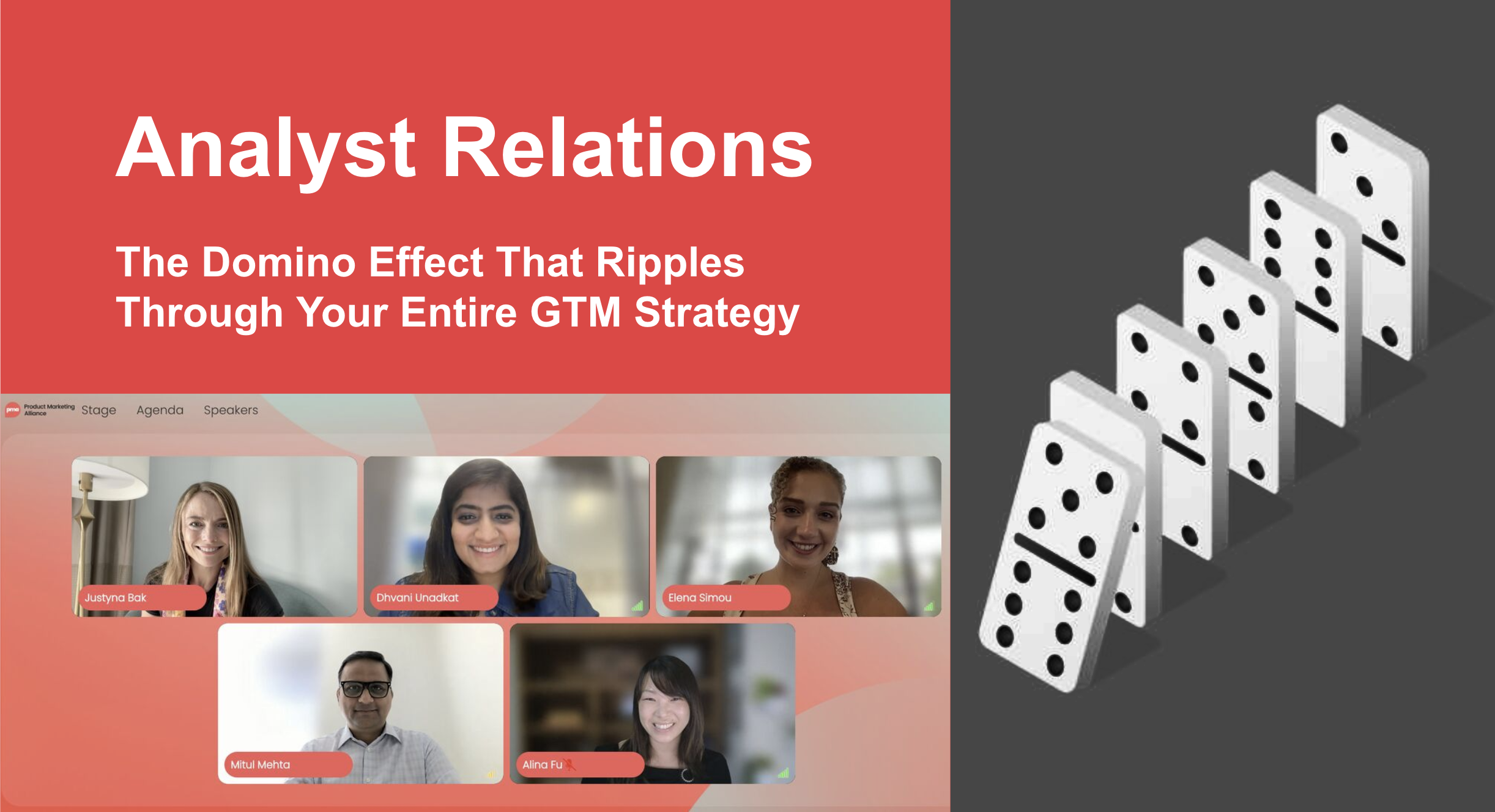
How trusted external voices can shape what you build, how you position it, and win the hearts and minds of your customers
When the Product Marketing Alliance invited me to speak at the Analyst Relations Summit, the title of the session, The Domino Effect: How Analyst Relations Should Ripple Through Your Entire GTM Strategy, immediately caught my attention.
Too often, analyst relations becomes a scoreboard exercise: brief the analysts, wait for the evaluation, then place the logo and quadrant in the sales deck. That is the final domino. The real value begins much earlier through a sustained, two way relationship. Analysts can surface market shifts and buyer needs, challenge roadmap assumptions, reveal competitive gaps, and pressure test whether positioning is clear and differentiated.
As a marketer, I’m passionate about turning complex technologies into adoption and revenue, and analyst relations has been a big part of my work. I have been at every end of the spectrum. As a VP of Marketing at an early stage startup, I worked hard to get on the radar of the key analysts. At Fortune 100 companies like Nokia, Cisco, and Google, where my company was already in the top right quadrants, my goal was to maintain leadership and innovator status.
Last week, the key perk of moderating the panel discussion was that I got 45 minutes to ask my esteemed peers – Mitul Mehta, CMO at Datamatics, Dhvani Unadkat Sheth, who leads Product Growth at PayPal, and Alina Fu, Director of Copilot Marketing at Microsoft – the questions burning in my head and I came away with a goldmine of insights. This article is my summary of our conversation.

One more thing before we start. In the era of AI, when a buyer asks an LLM which vendors to shortlist, the answer is assembled from third party sources, and analyst research is among the most heavily weighted of them. So the work you, your team and your partners in Product put into AR provides ROI well before you see it.
Domino #1: Are you building something the market actually needs?
Analysts sit across hundreds of buyer conversations a quarter. That is a data set no single company can replicate at such scale and without bias, and it’s worth tapping into it in the early stages of product definition to create cross-functional alignment.
Case in point, Mitul described a moment when his product, sales, and marketing teams deadlocked over how to price a new AI service. Product wanted token based pricing because tokens are expensive and the math had to work. Sales and marketing pushed back because a consumption model gives the buyer no way to predict spend. There was no precedent to fall back on, so they took the question to the analyst community. The feedback was blunt: customers were not yet convinced the ROI was there, and asking them to commit dollars up front against an unproven benefit would stall adoption. The company shipped a usage first model instead, let customers experience value before paying for it, and used the usage data to price properly later. Analysts broke the tie.
Then Dhvani reminded us that:
Analysts can put a macro lens on a micro problem.
In a B2B2C business at PayPal, Dhvani was solving for the merchant and the end shopper at the same time, and a single merchant conversation could not tell her whether the friction she just heard about is one account’s issue or a market wide pattern. Analyst input tells you which one you are looking at, and that determines whether it belongs on the roadmap.
In my opinion, bringing analysts in at the product definition stage is critical to building strong relationships that later on create room for candid feedback throughout the product lifecycle. I learned the same lesson at both startups and Fortune 100 companies: market traction begins with framing the problem in language the market understands. Sometimes the problem space is clearly defined, sometimes it’s being “shaped as you ship”.
When I was VP of Marketing at a Series B startup in the edge AI space, Synadia, I wanted to get us on Gartner‘s radar. I started by reading Gartner’s “2025 predictions for edge computing and AI” report, then mapped my platform to three challenges those trends would create: (1) running distributed applications reliably at the edge, (2) unifying AI data across cloud and edge, and (3) enabling AI agents to coordinate in real time. For each challenge, we connected the market trend to our differentiated capabilities and supported the story with customer evidence.
That exercise proved useful beyond the actual analyst briefing. It gave us a clearer way to articulate the market problem and explain our unique value. My lesson learned: use analyst research to understand how the market frames an emerging challenge, then develop your own point of view on how your product solves it.
Domino #2: Does your value land with your ICP?
Later on, Alina shared that Gartner’s early view of Microsoft Copilot was not favorable. There were reports listing the top gotchas and issues in every region.
Alina’s team decided objection handling was not a strategy. They built a coordinated program across product marketing, analyst relations, and product engineering, with the senior leaders of each in the room. Rather than argue with the criticism, they asked the analysts to hand over their punch list: every issue their clients cited as blocking or slowing adoption. The team expected around ten items. They got more than triple that. Then they worked the list like an engineering backlog, tracked sentiment against it, reviewed on a regular cadence, and closed more than 75 percent of the top issues in under six months.
They also stopped briefing and started sharing the product. Full licenses, preview capabilities ahead of general availability, and direct access to engineering when something broke. The number of analysts actively engaging with them doubled. Daily active use among those licensed analysts went above 90 percent. Alina’s team discovered that the research side of one firm did not know the IT side had already deployed Copilot. Nobody had connected them.
Alina’s Copilot example reminds us of an often under-appreciated value of AR.
Analysts are customer zero for your product (and possibly literal customers of it if you’re a major enterprise workload vendor).
My take-away from this portion of our discussion: late-stage objections are mostly determined months earlier. Aim for “no surprises”. Partner with analysts to surface objections and train your sales before those objections appear in the market. This takes real investment: free product seats at zero revenue, engineering on call for analyst escalations, a microsite someone keeps current, and a product leader who makes their calendar available for analyst sessions. The investment looks similar whether you’re a startup or a Fortune 100, the difference may lie in the number of analyst firms, total number of analysts to engage, and that your product may be more complex and with more history when you’re an enterprise vs. a new, smaller player.

Domino #3: How do you orchestrate growth and enablement programs?
Dhvani shared that in a B2B2C setting, conversion numbers are the best positioning test. From her time on the Amazon Ads side, the work towards getting in the top right quadrant did more than establish rank. It exposed market perception on the dimensions buyers actually cared about in AI powered advertising, which were transparency, governance, and control. That perception map shaped positioning, surfaced blockers, and told the team what advertiser mindset they were selling into.
Alina’s team built a curated microsite so analysts never had to hunt across the web for current product facts, testimonials, and adoption data. And they moved analyst feedback upstream of launch, incorporating it into capabilities before announcement rather than defending capabilities after it.
On enablement specifically, our panel had a consensus that the artifacts that travel furthest are rarely the direct quotes and broad endorsements. They are the total cost of ownership (TCO) models, the return on investment (ROI) analyses, and the third party framing of the problem that lets a seller open a conversation about the buyer’s business rather than your feature list.
My take-away: the assets that enable a seller and the assets that shape market perception are the same assets. Build the TCO model and the third party problem framing once, then make sure both your sellers and the market can find them.
Domino #4: What success metrics do you use to score your AR programs?
Mitul argued that the standard metrics, such as report presence and quadrant placement, measure the transaction rather than the relationship. His team scores analyst relationships the way they score customer accounts: how many analysts genuinely understand your positioning, whether their perception matches your reality, and how far your coverage extends into adjacent categories. If you sell automation, the automation analysts are the obvious set. The security and user experience analysts shape the same buying committee, and most programs never reach them.
He added a test I liked:
Do your analysts proactively call you when they hear something about you in the market?
If yes, you have a relationship. If no, you have a briefing calendar.
An audience question from Jennifer Hartwell asked how to track new customers making purchase decisions based on analyst rankings. Alina answered that it is multi touch attribution and deliberate instrumentation:
- Flag analyst asset usage in the CRM.
- Use conversation intelligence to catch the moments a quadrant or a TCO analysis actually moved a deal.
- And accept that customer evidence is the input that changes what analysts write about you in the first place, which makes it upstream of the ranking you are trying to attribute.
My take-away: measure the leading indicators across qualitative and quantitative metrics. Has any customer brought up a TCO analysis on a call that shows in Gong reports? Has a sales colleague pinged you that the ROI calculator with analyst input helped convince a skeptic on the buying committee?
And add one more. Ask the LLMs the questions your buyers ask, and log which vendors get named and how you are described. Imperfect and early, and still the only signal on this list that measures the stage where your buyer now actually starts.
The one thing
To wrap things up, I asked each panelist for a single action the audience could take that day.
- Alina’s was structural: stop letting AR sit alone. The default failure mode is a single team responsible for talking to analysts. The working model is a trifecta of product marketing, AR, and product engineering, because engineering is what makes the feedback loop credible.
- Dhvani’s was to treat analysts as P0 customers and route their feedback into the roadmap like any other customer signal.
- Mitul’s was a posture shift: AR is a strategic advisory function that runs through the roadmap, enablement, and go to market, not a transactional one that produces reports and mentions.
Mine is straightforward: start today. Set up one inquiry this week. Pick an analyst you have not spoken to in a while, read their latest research, and ask them what their clients are struggling with. Start mapping your GTM strategy and all the dominos but don’t let perfection stop you. While the North Star for your AR program may be the eval ranking, that’s the outcome of a long term AR strategy. Look for the leading indicators along the way and when in doubt, bias towards action and conversations.
The only way to build the chain is to set up the first domino.


Leave a Reply