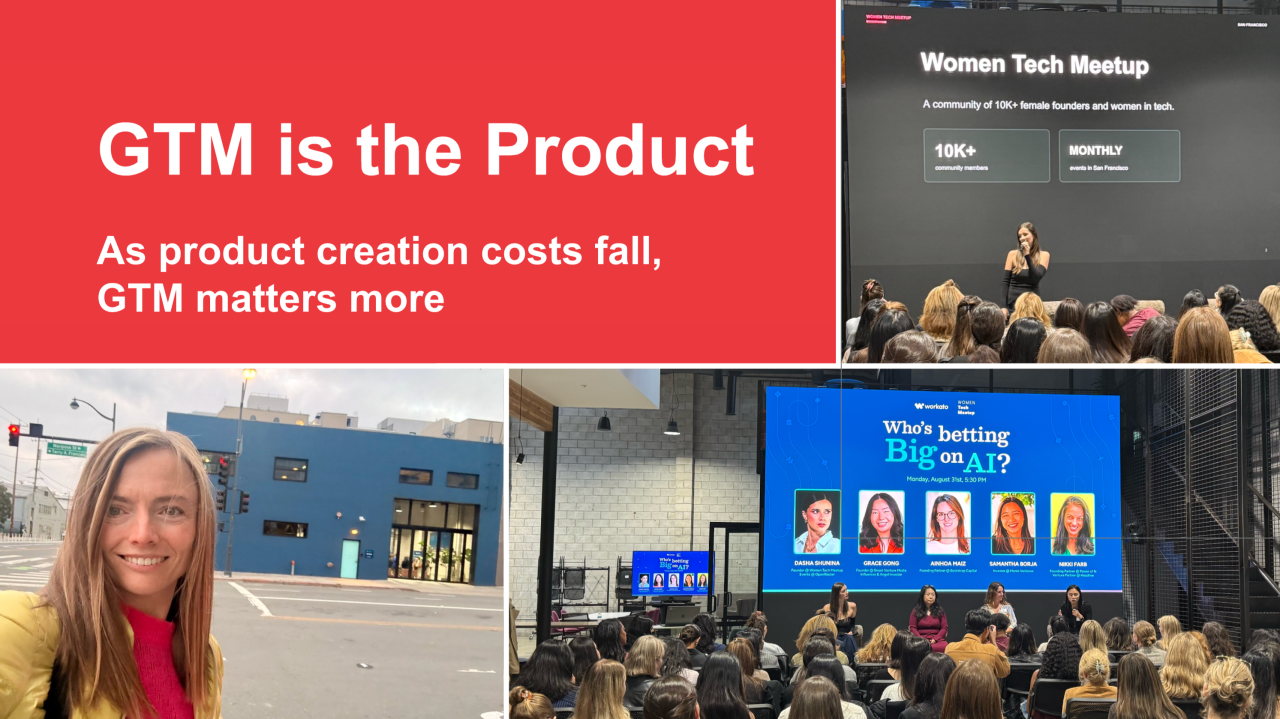
As product creation costs fall, GTM matters more
The barriers to building a software product were never lower. Just look at Claude Opus 4.8 released at the end of May 2026 to see how far the frontier has moved. Its new dynamic workflows feature in Claude Code can plan complex projects, coordinate hundreds of parallel agents, and verify their output. A founder can increasingly move from an idea to a functioning product with a fraction of the time, capital, and engineering resources previously required. And the AI we know today is the least capable AI we will ever use.
In an era where products can be built faster and product launch content can be generated instantly, what’s worth building and taking to market?
That question was at the heart of the recent Women Tech Meetup panel, “Who’s Betting Big on AI?”, held at Workato ’s office in San Francisco’s Dogpatch, and moderated by the one and only Dasha Shunina.

The panel brought together three investors with distinct perspectives on what makes an AI company valuable and durable:
- Grace Gong, founder of Smart Venture Media and an angel investor
- Samantha Borja, investor at Menlo Ventures
- Ainhoa (“Noa”) Maiz, founding partner at Bootstrap Capital Partners

Throughout the conversation, the panelists kept returning to the concept of first principles.
The term comes from Aristotle, who used it for a proposition that cannot be deduced from anything more basic. In business, most of us do the opposite. We reason by comparison:
What does the competitor charge?
First principles thinking asks a different question:
What’s the value for my target customer?
Mathematics has its own name for those irreducible truths. Axioms. In calculus, everything begins with a handful of them: space and time are continuous, limits exist, change can be quantified. From that short list you can derive rates of growth, accumulation of value, and optimization.
First principles in product management means getting back to the basics:
- What real problem is being solved?
- Why does it matter now?
- How frequently does the customer experience it? Is it a problem that needs solving once a year, such as filing taxes, or every day, such as managing a commute?
- How painful is the current solution, and is that pain significant enough to make someone change their behavior or purchase a new product?
As I listened, I wondered what would happen if we applied that same discipline to GTM.
So I raised my hand and asked:
Which GTM fundamental becomes even more important in the era of AI?

Grace’s answer was IRL:
In-person connection matters even more in the era of AI
As AI fills the internet with polished content and automated interactions, it becomes harder to know who or what to trust. Events and communities allow customers to encounter the humans behind a company. For Grace, physical presence helps create the trust that increasingly determines why someone chooses one company over another.
Samantha emphasized product experience:
Let people try the product before you ask them to pay for it.
Particularly at the application layer, customers need to experience value for themselves. As ambitious AI promises become easier to make, direct product experience becomes a powerful form of evidence.
Noa focused on white glove customer success:
Forward deployed engineers (FDEs) are vital to realizing business outcomes
Interestingly, the Sunday before this panel, I saw the definition of an FDE make it to the New York Times, a sign the role has crossed from Silicon Valley jargon into general business vocabulary.

For many enterprises a significant gap remains between owning the technology and making it work inside real data, workflows, and organizational constraints. Noa’s answer suggests that implementation is becoming inseparable from value creation. The promise made during the sale must continue until the customer achieves the outcome.
The panelists’ answers address three fundamental concerns across the customer journey:

In my book, Marketing Plan for Tech Startups, I talk a lot about the marketing fundamentals. I call them axioms: core truths that stay valid across products, industries, and stages. I rely on three.

- Scientific precision. For every product there is exactly one clear positioning statement linking its unique capability to a concrete customer need. Positioning is a discovery process, not guesswork.
- Emotional storytelling. In every purchasing decision, emotion precedes reason. Marketing has to create the feeling first so that logic can validate the choice afterward.
- Relentless consistency. A coherent message repeated compounds. An incoherent one decays toward zero.
Listening to the panel discussion, I noticed that all three answers were about evidence. Trust and first-hand experience give customers confidence in a decision they largely made emotionally at the start. On-site support does something different: it makes that decision turn out to be correct.
As products become easier to build, go to market becomes even more important.
In a market abundant with options, Emotional Storytelling earns attention and helps customers recognize themselves in your promise. Scientific Precision turns that promise into a credible decision through the right offer, proof, and evidence. Relentless Consistency carries the same promise across every interaction, from awareness and consideration through purchase, adoption, retention, and advocacy.
When products become easier to replicate, the complete customer experience becomes the enduring source of differentiation. That is why I am writing a new chapter, GTM in the Era of AI, for the relaunch of Marketing Plan for Tech Startups in October! Can’t wait to share what incredible thought leaders and frontier operators are contributing to it!
What go to market fundamental do you believe becomes more important in the era of AI?
PS. Shoutout to Adam Seligman , Ray Yuen and the Workato team for hosting the Women Tech Meetup at their beautiful Dogpatch office designed to resemble a Silicon Valley garage, where all unicorns started!


Leave a comment