Tag Archives: digital-marketing

GTM is the Product

8 Sep

As product creation costs fall, GTM matters more

The barriers to building a software product were never lower. Just look at Claude Opus 4.8 released at the end of May 2026 to see how far the frontier has moved. Its new dynamic workflows feature in Claude Code can plan complex projects, coordinate hundreds of parallel agents, and verify their output. A founder can increasingly move from an idea to a functioning product with a fraction of the time, capital, and engineering resources previously required. And the AI we know today is the least capable AI we will ever use.

In an era where products can be built faster and product launch content can be generated instantly, what’s worth building and taking to market?

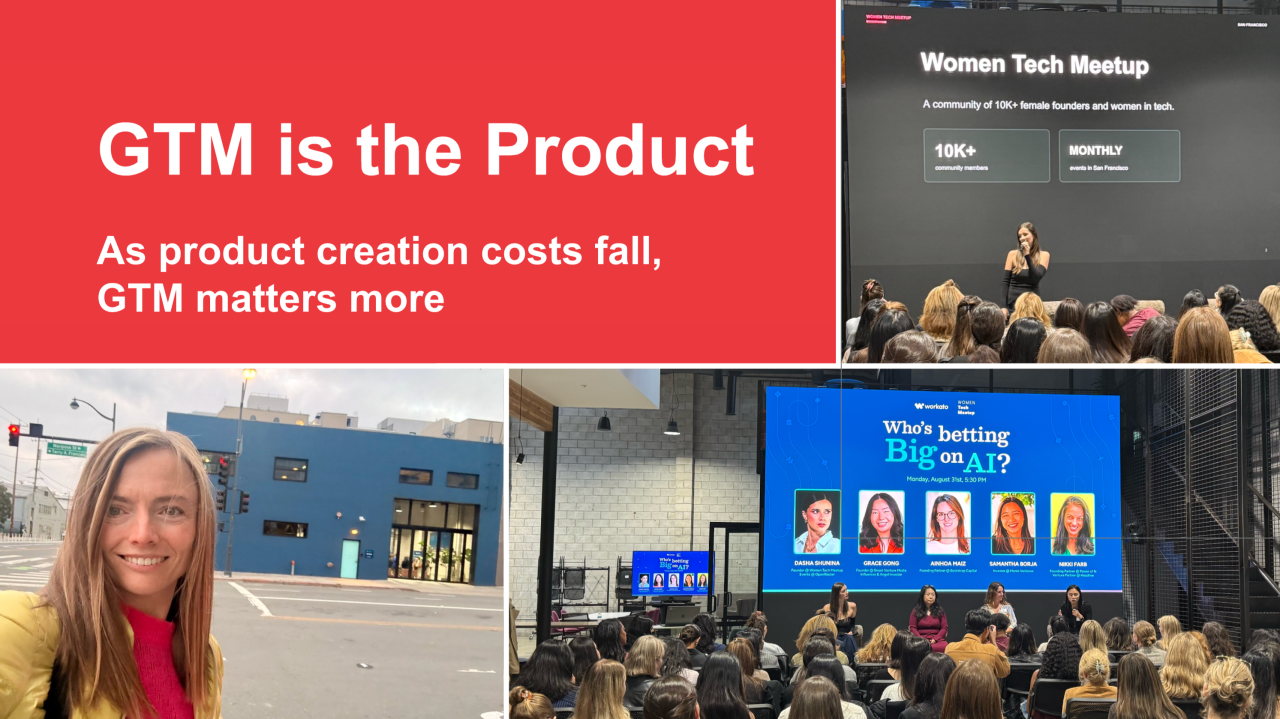
That question was at the heart of the recent Women Tech Meetup panel, “Who’s Betting Big on AI?”, held at Workato ’s office in San Francisco’s Dogpatch, and moderated by the one and only Dasha Shunina.

Article content

The panel brought together three investors with distinct perspectives on what makes an AI company valuable and durable:

Article content

Throughout the conversation, the panelists kept returning to the concept of first principles.

The term comes from Aristotle, who used it for a proposition that cannot be deduced from anything more basic. In business, most of us do the opposite. We reason by comparison:

What does the competitor charge?

First principles thinking asks a different question:

What’s the value for my target customer?

Mathematics has its own name for those irreducible truths. Axioms. In calculus, everything begins with a handful of them: space and time are continuous, limits exist, change can be quantified. From that short list you can derive rates of growth, accumulation of value, and optimization.

First principles in product management means getting back to the basics:

  • What real problem is being solved?
  • Why does it matter now?
  • How frequently does the customer experience it? Is it a problem that needs solving once a year, such as filing taxes, or every day, such as managing a commute?
  • How painful is the current solution, and is that pain significant enough to make someone change their behavior or purchase a new product?

As I listened, I wondered what would happen if we applied that same discipline to GTM.

So I raised my hand and asked:

Which GTM fundamental becomes even more important in the era of AI?

Article content

Grace’s answer was IRL:

In-person connection matters even more in the era of AI

As AI fills the internet with polished content and automated interactions, it becomes harder to know who or what to trust. Events and communities allow customers to encounter the humans behind a company. For Grace, physical presence helps create the trust that increasingly determines why someone chooses one company over another.

Samantha emphasized product experience:

Let people try the product before you ask them to pay for it.

Particularly at the application layer, customers need to experience value for themselves. As ambitious AI promises become easier to make, direct product experience becomes a powerful form of evidence.

Noa focused on white glove customer success:

Forward deployed engineers (FDEs) are vital to realizing business outcomes

Interestingly, the Sunday before this panel, I saw the definition of an FDE make it to the New York Times, a sign the role has crossed from Silicon Valley jargon into general business vocabulary.

Article content

For many enterprises a significant gap remains between owning the technology and making it work inside real data, workflows, and organizational constraints. Noa’s answer suggests that implementation is becoming inseparable from value creation. The promise made during the sale must continue until the customer achieves the outcome.

The panelists’ answers address three fundamental concerns across the customer journey:

Article content

In my book, Marketing Plan for Tech Startups, I talk a lot about the marketing fundamentals. I call them axioms: core truths that stay valid across products, industries, and stages. I rely on three.

Article content
  • Scientific precision. For every product there is exactly one clear positioning statement linking its unique capability to a concrete customer need. Positioning is a discovery process, not guesswork.
  • Emotional storytelling. In every purchasing decision, emotion precedes reason. Marketing has to create the feeling first so that logic can validate the choice afterward.
  • Relentless consistency. A coherent message repeated compounds. An incoherent one decays toward zero.

Listening to the panel discussion, I noticed that all three answers were about evidence. Trust and first-hand experience give customers confidence in a decision they largely made emotionally at the start. On-site support does something different: it makes that decision turn out to be correct.

As products become easier to build, go to market becomes even more important.

In a market abundant with options, Emotional Storytelling earns attention and helps customers recognize themselves in your promise. Scientific Precision turns that promise into a credible decision through the right offer, proof, and evidence. Relentless Consistency carries the same promise across every interaction, from awareness and consideration through purchase, adoption, retention, and advocacy.

When products become easier to replicate, the complete customer experience becomes the enduring source of differentiation. That is why I am writing a new chapter, GTM in the Era of AI, for the relaunch of Marketing Plan for Tech Startups in October! Can’t wait to share what incredible thought leaders and frontier operators are contributing to it!

What go to market fundamental do you believe becomes more important in the era of AI?

PS. Shoutout to Adam Seligman , Ray Yuen and the Workato team for hosting the Women Tech Meetup at their beautiful Dogpatch office designed to resemble a Silicon Valley garage, where all unicorns started!


Article content

Don’t Market Your Matterhorn to the Italians: A Lesson in Product-Market Fit 🏔️

17 Feb

Identifying your target segment is one of the most important steps in building an effective marketing strategy. It’s not just who you’re building for, but what part of your product they’ll actually value most.

Three years ago, I launched this newsletter by comparing five tech trends to five ski analogies. Keeping the tradition alive, here’s another winter story.

Meet the same mountain: 🇨🇭 Matterhorn to the Swiss, 🇮🇹 Cervino to the Italians.

Article content

One mountain. Two distinct audiences. Two value propositions.

  • Matterhorn (“Matte” = meadow, “Horn” = peak in German) dominates the Zermatt skyline and adorns everything from Toblerone bars to tourism campaigns. To the Swiss, its shape is iconic and source of pride. A clear, differentiated value prop.
  • Cervino, from the pre-Latin root karv (rock), competes in a crowded field. Think: Monte Bianco (Europe’s highest peak), Tre Cime di Lavaredo with the rugged peaks or the queen of the Dolomites, Marmolada. Beautiful? Absolutely. But in Italy, Cervino is just one of many.

So if you’re a marketer chasing product-market fit, the lesson is simple:

Make sure you’re marketing your Matterhorn to the Swiss, not the Italians.

Find the segment for whom your product is unforgettable.

The one who sees it as the only possible choice.

Just like Instagram did.

Instagram began in San Francisco as Burbn, a mobile check-in app created by Kevin Systrom rom and Mike Krieger. As the co-founders watched how users engaged with the product, one feature clearly rose above the rest: photo sharing. Everything else — location check-ins, gamified rewards — felt redundant next to Foursquare. After peaking at just 100 users, they made a bold decision to pivot. They stripped away all but the photo-sharing functionality, refined it with filters, and rebranded the app as Instagram: a name combining instant camera and telegram. [Source] Today, Instagram boasts more than 3 billion users. [Source]

Photo sharing with filters became to Instagram’s audience what the iconic, pyramid-shape of Matterhorn is to the Swiss: the one feature that made the product unforgettable.

Choosing the right target segment is critical, yet it’s only one of the 18 elements in a comprehensive go-to-market framework. If you want a practical structure for turning complex tech into adoption and revenue — with examples from companies like Google, Apple, Microsoft, Groq and Y Combinator — get my book 𝗠𝗮𝗿𝗸𝗲𝘁𝗶𝗻𝗴 𝗣𝗹𝗮𝗻 𝗳𝗼𝗿 𝗧𝗲𝗰𝗵 𝗦𝘁𝗮𝗿𝘁𝘂𝗽𝘀 ⬇️

📘 𝗣𝗿𝗲𝘃𝗶𝗲𝘄 𝘁𝗵𝗲 𝗯𝗼𝗼𝗸: ebook.techsurprises.com

📗 𝗚𝗲𝘁 𝘆𝗼𝘂𝗿 𝗰𝗼𝗽𝘆: amazon.techsurprises.com

📕 𝗟𝗲𝗮𝘃𝗲 𝗮 𝗿𝗲𝘃𝗶𝗲𝘄: review.techsurprises.com

#ProductMarketFit #MarketingStrategy #Segmentation #Positioning #Startups #GTM #Matterhorn #TechStartups #InnovationToRevenue

The Three Marketing Axioms That Never Fail Me

13 Aug

In mathematics, axioms are self-evident principles. They’re the foundation on which more complex theorems are built. Take calculus, my favorite branch of math. It starts with a handful of assumptions: space and time are continuous, limits exist, and change can be quantified. If you know how fast something is changing, you can figure out how much it’s changed — and vice versa. From there, you unlock entire worlds: rates of growth, accumulation of value, and optimization. Sounds a lot like marketing, doesn’t it? 😉

In marketing, axioms serve the same role. They help you recalibrate when markets shift, competitors surprise you, or new technologies (like gen AI) change the game.

The Three Axioms of Marketing

Over the years, I’ve returned to these three core axioms again and again, applying them through every tech wave from mobile to AI while working across startups and Fortune 100 companies in both Europe and Silicon Valley.

Axiom 1 – Scientific precision

For every product there exists exactly one clear positioning statement that links its unique capability to a concrete customer need.

The most effective marketers approach their product’s positioning statement as a discovery process, not guesswork. Positioning requires rigorous market analysis, a deep understanding of buyer personas, and an honest comparison to alternatives. When done correctly, positioning defines the North Star for the business and keeps Marketing, Sales and Product in sync and united.

To see scientific precision in action, let’s look at a fresh positioning example from the autonomous ride-hailing market. Waymo ’s trajectory shows how clear market definition and targeted messaging can carve out a profitable niche even in a highly competitive space.

Article content
Example of a positioning statement inspired by Waymo (San Francisco, August 2025)

In 2025, Business Insider and Reddit discussions revealed that Waymo rides cost about $5–6 more than Uber or Lyft, yet many riders valued the extra comfort, reliability, and privacy enough to pay the premium.

Without precision here, marketing risks scattering its efforts, diluting the message, and missing the target entirely.

Axiom 2 – Emotional storytelling

In every purchasing decision, emotion precedes reason. Marketing must first evoke feeling so that logic can later validate the choice.

Baba Shiv, a revered Marketing Professor at Stanford University Graduate School of Business, once stated, “Nearly 95% of our decisions in life are rooted in emotion—not logic.” You might wonder if this applies to business-to-business transactions, like enterprise software sales. The answer is a definite “Yes!

In the mid-2000s, Cisco ran its “Self-Defending Network” campaign to position its IT security solutions as proactive, intelligent defenders of an organization’s assets. Rather than focusing solely on firewalls, intrusion prevention, or encryption standards, Cisco told stories of real people whose work and reputations were safeguarded because the network stopped threats before they could cause harm.

Article content
Cisco’s The Power of The Network Campaign

If you’re an enterprise sales executive, you probably realize that customers often decide in favor or against your product early in the sales cycle. What follows is essentially an opportunity for the customer to validate their initial decision. This phase involves testing your product, examining ROI calculators, or seeking peer reviews to gain confidence in the choice they’ve already made.

In summary, customers make decisions emotionally and then rationalize them.

Axiom 3 – Relentless consistency

Repeated delivery of a coherent message compounds its impact over time, while inconsistency diminishes effectiveness toward zero.

Consistency turns your positioning into a memory imprint. Each content interaction, ad view, and social media conversation must reinforce the same promise.

This is about disciplined alignment: sales decks matching web copy, product announcements echoing the same value proposition, and customer success stories reinforcing the same themes.

Over months and years, consistency builds trust and recognition in ways no single campaign can match. Break the thread too often, and you start again from zero.

Vanta ’s years-long commitment to podcast advertising shows how repetition in the right channels compounds over time. Starting in niche security shows like This Week in Startups and CISO-focused podcasts, and expanding to mainstream business podcasts such as Acquired, The Daily, (my personal favorite: The AI Daily Brief by Nathaniel Whittemore), and The Diary of a CEO, they’ve kept the core message intact. The result: thousands of sales conversations where prospects bring up hearing about Vanta “all the time.” That’s consistency turning positioning into muscle memory.

In their CMO Scott Holden‘s own words: Vanta gets a lot of attention for our billboards, but podcasts are a massive lever for us too. We’ve been advertising in them since 2018. (…) All those demo requests that sales loves begin higher up the funnel.”

Article content
Vanta advertised for years on podcasts for their target audience: CISOs who’s spend 100s of thousands of dollars on their security software

From Calculus to Product Launches

These axioms have guided me across decades of tech shifts:

  • 2000s – Mobile Internet. At Nokia, I built software tapping directly into telecom APIs, turning raw network data into useful services I then helped take to market for clients like Vodafone, Telenor and TIM.
  • 2010s – Cloud Computing. At Cisco and Riverbed Technology I distilled the value of cloud computing before it became the backbone of digital transformations at Fortune 500 enterprises.
  • 2020s – Data Analytics and Gen AI. At Google, I crafted portfolio-wide narratives for data and AI products and enabled 13,000 sellers to tell those stories effectively.
Article content
  • 2025 – Edge and Agentic AI. At Synadia a cloud-native startup, I repositioned middleware into a full-stack edge AI platform: a key enabler for agentic AI at the edge in retail, automotive and manufacturing.

The Marketing Axioms in the AI Era

Marketing a category-defining product (gen AI, self-driving cars, or the next leap in biotech) is like solving a math problem no one has worked out before.

There’s no answer key. But the path forward still starts with fundamentals.

In AI-powered marketing today, that might mean taking a single high-performing message and using AI to instantly create dozens of localized, role-specific, or vertical-tailored variations. The goal is to preserve the original emotional heartbeat and positioning clarity.

Final thought: In both math and marketing, axioms don’t give you the full solution. They give you the foundation that makes finding it possible.

Turning Innovation Into Revenue

If you enjoyed this post and would like to continue the journey into the three axioms of marketing, I have exciting news: 10 years after publishing my Marketing Plan for Tech Startups template (which reached more than 100k readers) I’m turning it into a full book:

Article content

Be the first to get your copy of Marketing Plan for Tech Startups (And Not Only) — sign up here: https://techsurprises.com/the-book/

Join me on the ride — the book’s coming soon!

Article content